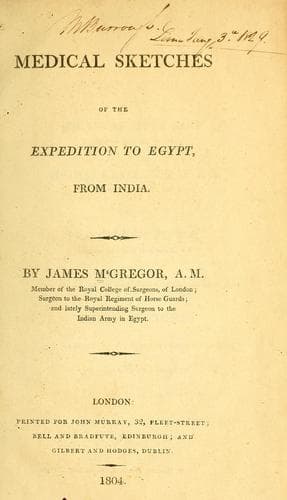
Medical Sketches of the Expedition to Egypt, from IndiaMcGrigor, James, Sir
History
Medical Sketches of the Expedition to Egypt, from India
McGrigor, James, Sir
Great Britain. Army -- Sanitary affairs; Medicine, Military
In September, a great many cases occurred in the neighbourhood of
Rosetta, and in the camp at El Hammed; but many of these were the sequelæ
of the fever contracted at Rhoda. In October, the number of cases was
greatly on the increase. The rainy weather with which the month of
November began, and which continued during the following months, brought
a prodigious increase of dysenteric cases. In the general return of the
first week in November, there appear one hundred and sixty cases, and one
hundred and twenty-three of these are Europeans. Most of the natives were
from the Bengal volunteer battalion.
In the first general return in December appear two hundred and nineteen;
of which one hundred and forty are Europeans.
After leaving the encampment at El Hammed, and getting into dry,
comfortable barracks, at Alexandria, the disease occurred more rarely in
the army.
In the last return of January, only one hundred and sixty cases are seen.
In the last return of February, the total number of dysenteric cases in
the army was fifty-four, and only twenty-two of these were natives of
India.
In the last return of March, there appear nineteen cases, fifteen of
which were Europeans.
There are only twenty cases in the last return of April, and these cases
are equally divided between the Europeans and Indians.
At the time of embarkation the number was even less than the above.
The disease was more frequently met with among the European artillery,
and in the 61st regiment, than in any other corps. Among the native
corps, the Bengal battalion had more of the disease than any other.
I made inquiry, but could find no reason that could with probability
account for this.[8]
I have continued longer on the subject of dysentery than was at first my
intention. I will confess, that I think it is a subject on which I could
with more propriety speak than on any other. My opportunities of seeing
the disease have been no common ones. Rarely, I believe, has it fallen to
the lot of an individual to see so very many cases of one disease in such
a diversity of climate and situation. In the 88th regiment, during the
course of upwards of ten years, I saw the same men the subject of this
disease on the continent of Europe, in America, in both extremities of
Africa, and in India. Of late, it has afforded me not a little amusement
to review my notes as well as my journals of practice in this disease, in
all these quarters.
I have now both given some account of the endemic diseases which we met
with in Egypt, and offered a few remarks on those diseases which were
most prevalent in the army. They are the diseases which constantly prove
the most fatal to an army in India. The few which now remain, or (if I
may be allowed the expression) the minor diseases, will not long detain
us.
PNEUMONIA AND RHEUMATISM
Public-domain text, read in full here on John Shaqi.
Reviews
Reviews
No reviews yet
Be the first to share your thoughts on this work.
Elsewhere in the archive
Join the Discussion
Join the discussion
Sign in to leave a comment or review.
Sign InorCreate an account