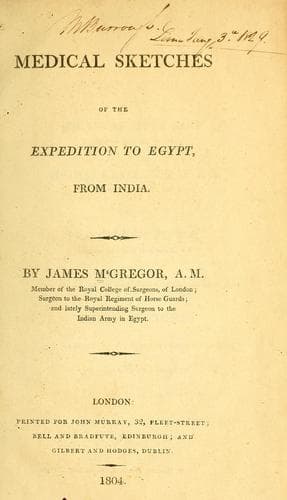
Medical Sketches of the Expedition to Egypt, from IndiaMcGrigor, James, Sir
History
Medical Sketches of the Expedition to Egypt, from India
McGrigor, James, Sir
Great Britain. Army -- Sanitary affairs; Medicine, Military
The disease was pretty uniform in the manner of its appearance. The
patient was first sensible of an itching; and, on looking at the part,
generally observed a small blister: sometimes I have seen three or four
small blisters, and the part having the appearance of being stung with
nettles. When the blister was snipped, a piece of mucus of the breadth
of a sixpence was seen underneath, which being removed, the head of the
worm was seen. It was in general firmly attached, and required force to
detach it from the parts underneath. When detached with the forceps, we
twisted it round a ligature or piece of lint, and thus, often on the
first day, succeeded in extracting a foot, or even two, of the worm. It
resembled much what is called bobbin, and was about the same size. It was
transparent and moist, a white liquid being seen in it. We continued,
daily, extracting as much of it as would come out with gentle pulling. It
was always dangerous to pull strongly, for fear of breaking the worm: it
then occasioned the most acute pain, and there followed much swelling,
with inflammation of the neighbouring parts, sometimes of two or three
weeks continuance, when the worm would shew itself at another part, as at
first, with itching and a blister.
It seldom appeared to be deeply seated; generally, under the cutis, or
among the tela cellulosa, when we could often trace it in its course, and
sometimes see it: sometimes it was under the fascia, and but seldom among
the muscles.
If not ushered in with fever, it was almost always attended with it in
its course: when there was considerable inflammation, it ran very high.
In seven cases, mortification took place, and very large sloughs were
cast off. In a few cases, there was a very considerable and alarming
hæmorrhage.
By presenting itself at different places, it would often leave two or
three large, foul, and fistulous ulcers in different parts of a limb.
When the inflammation has run very high, as I have often seen of the
whole leg or thigh; and when a profuse suppuration followed; the worm
frequently has come out dead, often in pieces, with the sanies, by
which, probably, it had been eroded and killed.
Frequently, after extracting one worm from a patient, a second, a third,
or even a fourth, would appear: after getting one out of a leg, a second
would appear in the other, a third in one hand, and a fourth in the other
hand.
The Guinea-worm, I believe, has been seen in every part of the body.
Though the extremities appear to be its favourite seats, yet the face,
breast, back, penis, &c. are not exempted from its visits. I heard of a
gentleman in Bombay who had one in his scrotum and penis, and of a lady
who had one in the pudenda.
The following I extract from my case-book and notes, taken on board the
Minerva, by which it will be seen that the extremities are as much more
frequently its principal and first seat, as in the itch.
Public-domain text, read in full here on John Shaqi.
Reviews
Reviews
No reviews yet
Be the first to share your thoughts on this work.
Elsewhere in the archive
Join the Discussion
Join the discussion
Sign in to leave a comment or review.
Sign InorCreate an account