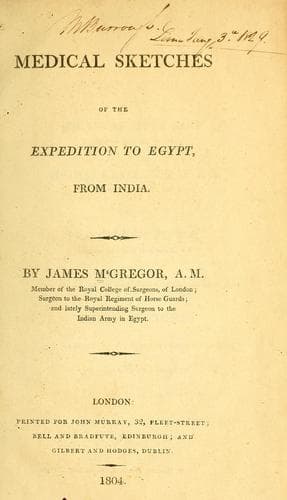
Medical Sketches of the Expedition to Egypt, from IndiaMcGrigor, James, Sir
History
Medical Sketches of the Expedition to Egypt, from India
McGrigor, James, Sir
Great Britain. Army -- Sanitary affairs; Medicine, Military
+-----+-----+-----+-------+--------+------+------+-----+-----+-------+
| | | | | | | | | | Total |
| | Feet| Legs| Thighs| Scrotum| Groin| Hands| Arms| Body| Cases.|
| +-----+-----+-------+--------+------+------+-----+-----+-------+
|Feb. | 34 | 3 | 1 | — | — | 1 | — | — | 39 |
|Mar. | 70 | 21 | 5 | 2 | 2 | 3 | — | — | 103 |
|April| 20 | 9 | 5 | — | — | 3 | — | 2 | 39 |
+-----+-----+-----+-------+--------+------+------+-----+-----+-------+
|Total| 124 | 33 | 11 | 2 | 2 | 7 | — | 2 | 181 |
+-----+-----+-----+-------+--------+------+------+-----+-----+-------+
As to the causes of the appearance of the Guinea-worm, and the mode in
which it is generated, I must confess that I have no account that I could
venture to offer here.
In different parts of the world, the water drank is accused of
occasioning intestinal worms, as the tænia in Switzerland, and the
tænia and the teretes in the West Indies; where, likewise, I have
heard the mucilaginous vegetables eaten assigned as a cause of the
frequent appearance of worms. In Russia, there is a worm, the lumbricus
militensis, common near swampy grounds. In Russia and in Siberia, in the
same situations, the tænia infernalis prevails. But, after what has
been here stated, we cannot bring the water, drank on board the Minerva,
or at Bombay, to account for the Guinea-worm which prevailed: in fact,
the water came from different and distant quarters, Bombay, Ceylon, and
Madras. Besides, the officers of the 38th, and the artillery, drank the
same water, and escaped.
No case of Guinea-worm had been known among either the Lascars or
European sailors in the Minerva, when the 86th and 88th embarked in her.
I have good reason to think that the spreading of the Guinea-worm may be
stopped, whenever it does appear. The means which we adopted appeared to
succeed. Extreme attention to cleanliness is indispensably necessary.
In India, the native doctors are much more successful in getting out the
worms, than Europeans. After long feeling with their fingers, for the
body of the worm, they make an incision as nearly as they can judge over
its middle, and, pulling the worm by a duplicature of it, draw out both
ends of the worm at one time. I have often endeavoured to imitate this
practice. My sense of touch was not so delicate, and did not guide me so
correctly, as it did the Hindoo doctors; but I always found that when, on
cutting down to it, I got on the middle of the worm, and, by the forceps,
pulled this out, I could with ease extract a large portion, and, not
unfrequently, the whole worm.
Public-domain text, read in full here on John Shaqi.
Reviews
Reviews
No reviews yet
Be the first to share your thoughts on this work.
Elsewhere in the archive
Join the Discussion
Join the discussion
Sign in to leave a comment or review.
Sign InorCreate an account