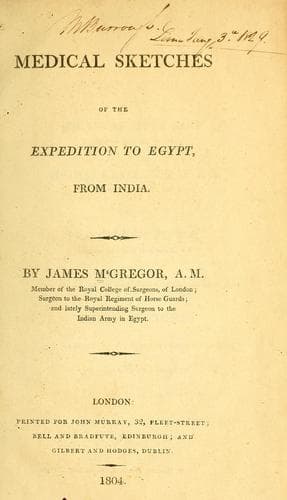
Medical Sketches of the Expedition to Egypt, from IndiaMcGrigor, James, Sir
History
Medical Sketches of the Expedition to Egypt, from India
McGrigor, James, Sir
Great Britain. Army -- Sanitary affairs; Medicine, Military
5th. The state of the other corps, after sailing from Tortola, I am
unacquainted with. When lying at Tortola, on the 29th and 30th of July,
the Betsy communicated with the transports which had the 8th and 10th
regiments on board. On the 6th of August, the first case of the yellow
fever appeared on board the Betsy; from which period to the 12th of
September, 1796, every person almost was once, and a great many on board
twice, attacked with this fever. Of one hundred and forty people on board
the Betsy, the captain of the ship, eighteen soldiers, and one woman,
died in this period. It should, however, be mentioned, that, of the
soldiers, several were old and worn-out invalids. During the passage from
Tortola to England, our convoy, the Hebe frigate, suffered even more than
the Betsy. When sent for on board, by Captain Scott, I found that he
had not only lost many seamen and marines, but several officers, and two
medical gentlemen.
6th. On the fleet, from Grenada, anchoring at Tortola, the yellow fever
was unknown there; thereafter, I have heard, that it prevailed generally,
and committed great havoc.
7th. Those labouring under dysentery, ague, &c. were those first seized
with this fever.
8th. [_Symptoms._]—The attack was first with extreme debility, affection
of the head, and frequently the appearance of drunkenness. Next, the
abdomen was complained of, and the biliary system appeared to be a
principal seat of the disease. The yellowness, though not a constant,
was a generally attending symptom. The eyes first appeared of a watery
suffusion; they next were observed to be blood-shot; and, in a short
time after, yellow; from the eye, the yellowness quickly spread over
all the body, and the patient in a little time had the appearance of one
highly jaundiced. Sometimes the yellow colour of the body continued for
some time after the patient got well, and purgatives brought off yellow
stools, while the urine was at the same time yellowish. The irritability
of the stomach, and what is called the black vomiting, were pretty
constant attending symptoms. The state of the pulse varied in the course
of the disease; there was at first, almost always, a firm and strong
pulse, with so much re-action, as would lead a stranger to the disease
to blood-letting and the anti-phlogistic regimen. The bowels were, in
general, very unequal; there was either a looseness or costiveness,
though most frequently the latter.
9th. The duration of the disease was, in different cases, and in
different situations, very different. In Grenada, when it first broke
out, it generally ran its course from twenty-four, thirty-six, to
forty-eight hours, in the hospitals. Soon after we sailed from Grenada,
cases terminated in three days: thereafter, and as we approached the
higher latitudes, and before we reached Ireland, cases were drawn out to
ten, twelve, and fifteen days.
Public-domain text, read in full here on John Shaqi.
Reviews
Reviews
No reviews yet
Be the first to share your thoughts on this work.
Elsewhere in the archive
Join the Discussion
Join the discussion
Sign in to leave a comment or review.
Sign InorCreate an account