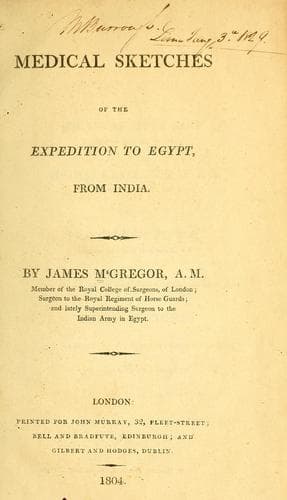
Medical Sketches of the Expedition to Egypt, from IndiaMcGrigor, James, Sir
History
Medical Sketches of the Expedition to Egypt, from India
McGrigor, James, Sir
Great Britain. Army -- Sanitary affairs; Medicine, Military
Dr Robertson, in one letter says, “I decidedly agree with you, that there
is a strong similitude between the symptoms of the yellow fever and the
plague: although the latter disease never came under my observation, yet
I was so struck with the appearance of yellow fever, and the histories
of the other disease, which I had read, that, at one time, I was almost
disposed to consider them both as different modifications of the same
diseased state of body, and actually wrote a paper on the subject in
February, 1797.”
In the practice in Egypt, Mr Price’s observation militates against the
use of cold bathing in the plague. It should be recollected, however,
that, when Mr Price made his observation, it was in the severest part of
the season, when the plague raged the most, and when Mr Price laboured
under many disadvantages in his practice. I anxiously wish to see cold
bathing, or sponging, extensively tried in the plague. I have great
expectations from it in that disease, from having so often seen how much
it has done in the yellow fever and in typhus fever, where I consider it
to be the most valuable part of the treatment.
In concluding, I am impelled to do an act of justice, and acquit myself
of a debt of gratitude. The use of this invaluable remedy, and what else
I know of tropical practice, I learned many years ago from my venerable
and much-respected friend Dr Wright. By the use of the cold bathing, my
life was saved in Jersey, in 1794, when I was ill of typhus fever, by
Dr Jackson, then surgeon of the Buffs, who, at the same time, attended
my hospital for me, and with the greatest benefit, and introduced this
practice into the 88th regiment, where typhus then raged.
The use of cold water and cold bathing has since been diffused by the
ingenious and elegant pen of Dr Currie. This I conceive to be one of the
greatest improvements which the practice of physic has received in modern
times.
FOOTNOTES
[1] A plan established in the army proved so useful, that I will here
mention it. The letters and reports of the medical gentlemen in the
pest-houses, I constantly sewed together, made them up in monthly
volumes, and kept them at my quarters, where every medical gentleman in
the army was invited to come and daily peruse them. The disease became
thus the subject of daily discussion; and, from these discussions, I was
enabled daily to propose queries in my letters to the gentlemen in the
pest-houses. Thus, the history of the disease, in most of its points,
came to be investigated; and, previously to entering a pest-house, before
his tour of duty came round, every gentleman had acquired some knowledge
of the plague, and of the success of other practitioners.
[2] These circumstances I learned from a member of the French Institute,
and from the Pharmacien en Chéf to the French army, who often related to
me the order which Bonaparte gave him to poison the wounded with opium.
Public-domain text, read in full here on John Shaqi.
Reviews
Reviews
No reviews yet
Be the first to share your thoughts on this work.
Elsewhere in the archive
Join the Discussion
Join the discussion
Sign in to leave a comment or review.
Sign InorCreate an account