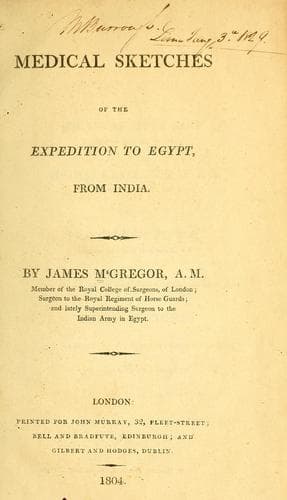
Medical Sketches of the Expedition to Egypt, from IndiaMcGrigor, James, Sir
History
Medical Sketches of the Expedition to Egypt, from India
McGrigor, James, Sir
Great Britain. Army -- Sanitary affairs; Medicine, Military
[3] In Dr Duncan’s Annals of Medicine, for 1801, I have adduced a
striking instance of this.
[4] Dr Buchan was on the staff of the British army, but twice nobly
volunteered his services, and twice did duty in the lazaretto of
Alexandria, at this period common both to the English and Indian armies.
[5] This remark we found to be particularly applicable to the last stages
of the disease. In the beginning of the season, one case occurred that
gave rise to much conversation in the army. From having come into contact
with a case of plague, a Lascar, in the department of the commissary of
cattle, was sent into the observation-room of the pest-house of Rosetta;
he was brought there much against his will, and contrived to make his
escape from it, on the evening of the day on which he was admitted,
though fired at by the dragoon-centries placed round the establishment.
Ineffectual search was made for him every where in the neighbourhood of
Rosetta, and we could hear nothing of him for about five weeks, when he
was discovered at Boulac. On being brought down to Rosetta, I examined
him with Mr Guild, the surgeon of his corps. We found him then well; but
certainly he had had the disease, for we saw an axillary bubo not quite
healed. He told us, that he remained concealed for a great part of the
time among the rushes by the side of the river. On mentioning this case
to Dr Currie, of Liverpool, I think he said, he had heard of some similar
cases.
[6] Since my arrival in England I see that the contagious nature of the
Egyptian ophthalmia has been noticed by two gentlemen of the English
army, Mr Edmonstone and Mr Powers.
[7] Though this practice is now followed by many gentlemen in India, yet
I believe that it has been carried to a greater extent by Messrs Dean and
Bellars, of the 86th regiment, than by any other practitioners. These
gentlemen have recorded several hundreds of cases of dysentery treated
solely by nitric mixture and bath.
[8] In Egypt we gave trial to a mode of treatment which was strongly
recommended to me by Dr Whyte. It was the application of flannel bandages
over the whole abdomen. In chronic cases, and in convalescents, it
appeared to be of the greatest service; and, in recent cases, when the
appropriate remedies were used at the same time, it appeared to shorten
the cure. I have seen it tried alone but in a few cases of this disease.
From the result of these, however, in cases of either the European or
tropical dysentery, I would not venture to rely on it alone for a cure.
Public-domain text, read in full here on John Shaqi.
Reviews
Reviews
No reviews yet
Be the first to share your thoughts on this work.
Elsewhere in the archive
Join the Discussion
Join the discussion
Sign in to leave a comment or review.
Sign InorCreate an account