Medieval English Nunneries c. 1275 to 1535 — John Shaqi
Medieval English Nunneries c. 1275 to 1535Power, Eileen
History
Medieval English Nunneries c. 1275 to 1535
Power, Eileen
Convents -- England; Monastic and religious life of women -- History
Produced by Bryan Ness and the Online Distributed
Proofreading Team at http://www.pgdp.net (This file was
produced from images generously made available by The
Internet Archive/American Libraries.)
CAMBRIDGE STUDIES
IN MEDIEVAL LIFE AND THOUGHT
Edited by G. G. COULTON, M.A.
Fellow of St John's College, Cambridge
and University Lecturer in English
MEDIEVAL ENGLISH NUNNERIES
CAMBRIDGE UNIVERSITY PRESS
C. F. CLAY, MANAGER
LONDON: FETTER LANE, E.C. 4
NEW YORK: THE MACMILLAN CO.
BOMBAY }
CALCUTTA } MACMILLAN AND CO., LTD.
MADRAS }
TORONTO: THE MACMILLAN CO.
OF CANADA, LTD.
TOKYO: MARUZEN-KABUSHIKI-KAISHA
ALL RIGHTS RESERVED
[Illustration: PLATE I
PAGE FROM _LA SAINTE ABBAYE_
(At the top of the picture a priest with two acolytes prepares the
sacrament; behind them stand the abbess, holding her staff, her chaplain
and the sacristan, who rings the bell; behind them a group of four nuns,
including the cellaress with her keys. At the bottom is a procession of
priest, acolytes and nuns in the quire.)]
MEDIEVAL ENGLISH NUNNERIES
c. 1275 to 1535
BY EILEEN POWER
SOMETIME FELLOW AND LECTURER
OF GIRTON COLLEGE CAMBRIDGE
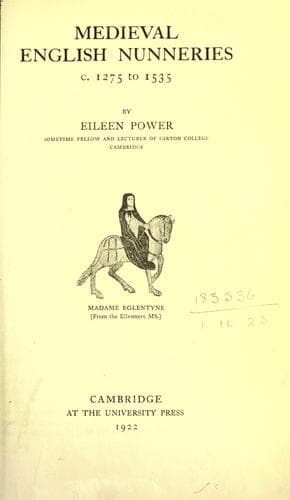
[Illustration: MADAME EGLENTYNE (From the Ellesmere MS.)]
CAMBRIDGE
AT THE UNIVERSITY PRESS
1922
TO M. G. J.
PRINTED IN GREAT BRITAIN
GENERAL PREFACE
There is only too much truth in the frequent complaint that history, as
compared with the physical sciences, is neglected by the modern public.
But historians have the remedy in their own hands; choosing problems of
equal importance to those of the scientist, and treating them with equal
accuracy, they will command equal attention. Those who insist that the
proportion of accurately ascertainable facts is smaller in history, and
therefore the room for speculation wider, do not thereby establish any
essential distinction between truth-seeking in history and truth-seeking
in chemistry. The historian, whatever be his subject, is as definitely
bound as the chemist "to proclaim certainties as certain, falsehoods as
false, and uncertainties as dubious." Those are the words, not of a modern
scientist, but of the seventeenth century monk, Jean Mabillon; they sum up
his literary profession of faith. Men will follow us in history as
implicitly as they follow the chemist, if only we will form the chemist's
habit of marking clearly where our facts end and our inferences begin.
Then the public, so far from discouraging our speculations, will most
heartily encourage them; for the most positive man of science is always
grateful to anyone who, by putting forward a working theory, stimulates
further discussion.
Public-domain text, read in full here on John Shaqi.
Reviews
Reviews
No reviews yet
Be the first to share your thoughts on this work.
Join the Discussion
Join the discussion
Sign in to leave a comment or review.
Sign InorCreate an account