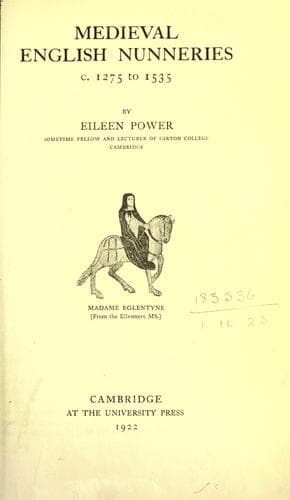
Medieval English Nunneries c. 1275 to 1535Power, Eileen
History
Medieval English Nunneries c. 1275 to 1535
Power, Eileen
Convents -- England; Monastic and religious life of women -- History
Usually the workers got their board during harvest and very well they
fared. The careful treasuresses of St Michael's get in beef and mutton and
fish for them, to say nothing of eggs and bread and oatmeal and foaming
jugs of beer. Porringers and platters have to be laid in for them to feed
from; and since they work until the sun goes down, candles must be bought
to light the board in the summer dusk. At the end of all, when the last
sheaf was carried to the barn and the last gleaner had left the fields,
the nuns entertained their harvesters to a mighty feast.
It was a time for hard work and for good fellowship. Says Tusser:
In haruest time, haruest folke, seruants and all,
should make all togither good cheere in the hall:
And fill out the black boule of bleith to their song,
and let them be merie all haruest time long.
Once ended thy haruest let none be begilde,
please such as did helpe thee, man, woman and childe.
Thus dooing, with alway such helpe as they can,
those winnest the praise of the labouring man[354].
The final feast was associated with the custom of giving a goose to all
who had not overturned a load in carrying during harvest, and the nuns of
St Michael's always enter it in their accounts as "the expenses of the
sickle goose" or harvest goose.
For all this good feasting, yet art thou not loose
till ploughman thou giuest his haruest home goose.
Though goose go in stubble, I passe not for that,
let goose haue a goose, be she leane, be she fat[355].
An echo of old English gaiety sounds very pleasantly through these harvest
expenses.
(5) _The wages sheet._ The last set of expenses which the monastic
housewife entered upon her roll was the wages sheet of the household, the
payments for the year, or for a shorter period, of all her male and female
dependents, together with the cost of their livery and of their allowance
of "mixture," when the convent gave them these. We saw in the last chapter
that the nuns were the centre of a small community of farm and household
servants, ranging from the reverend chaplains and dignified bailiff
through all grades of standing and usefulness, down to the smallest
kitchen-maid and the gardener's boy.
Public-domain text, read in full here on John Shaqi.
Reviews
Reviews
No reviews yet
Be the first to share your thoughts on this work.
Elsewhere in the archive
Join the Discussion
Join the discussion
Sign in to leave a comment or review.
Sign InorCreate an account