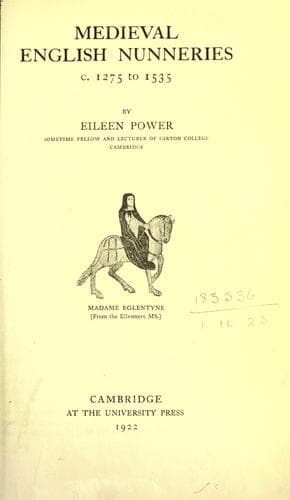
Medieval English Nunneries c. 1275 to 1535Power, Eileen
History
Medieval English Nunneries c. 1275 to 1535
Power, Eileen
Convents -- England; Monastic and religious life of women -- History
Such is the tale of the account rolls. It may be objected by some that
this talk of tenement-building, and livestock, ploughshares and
harvest-home has little to do with monastic life, since it is but the
common routine of every manor. But this is the very reason for describing
it. The nunneries of England were firmly founded on the soil and the nuns
were housewives and ladies of the manor, as were their sisters in the
world. This homely business was half their lives; they knew the kine in
the byre and the corn in the granary, as well as the service-books upon
their stalls. The sound of their singing went up to heaven mingled with
the shout of the ploughmen in the field and the clatter of churns in the
dairy. When a prioress' negligence lets the sheepfold fall into disrepair,
so that the young lambs die of the damp, it is made a charge against her
to the bishop, together with more spiritual crimes. The routine of the
farm goes on side by side with the routine of the chapel. These account
rolls give us the material basis for the complicated structure of monastic
life. This is how nuns won their livelihood; this is how they spent it.
CHAPTER IV
MONASTIC HOUSEWIVES
Some respit to husbands the weather may send,
But huswiues affaires haue neuer an end.
TUSSER, _Fiue Hundred Pointes of Good Husbandrie_ (1573).
Every monastic house may be considered from two points of view, as a
religious and as a social unit. From the religious point of view it is a
house of prayer, its centre is the church, its _raison d'etre_ the daily
round of offices. From the social point of view it is a community of human
beings, who require to be fed and clothed; it is often a landowner on a
large scale; it maintains a more or less elaborate household of servants
and dependents; it runs a home farm; it buys and sells and keeps accounts.
The nun must perforce combine the functions of Martha and of Mary; she is
no less a housewife than is the lady of the manor, her neighbour. The
monastic routine of bed and board did not work without much careful
organisation; and it is worth while to study the method by which this
organisation was carried out.
Public-domain text, read in full here on John Shaqi.
Reviews
Reviews
No reviews yet
Be the first to share your thoughts on this work.
Elsewhere in the archive
Join the Discussion
Join the discussion
Sign in to leave a comment or review.
Sign InorCreate an account