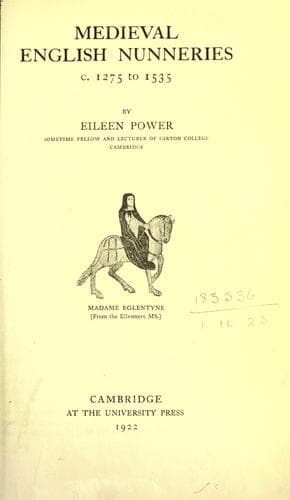
Medieval English Nunneries c. 1275 to 1535Power, Eileen
History
Medieval English Nunneries c. 1275 to 1535
Power, Eileen
Convents -- England; Monastic and religious life of women -- History
A very detailed set of instructions how to cater for a large abbey is to
be found in a Barking document called the _Charthe longynge to the office
of the Celeresse of the Monasterye of Barkinge_[361]. (8) The _Kitcheness_
superintended the kitchen, under the direction of the cellaress. (9) The
_Infirmaress_ had charge of the sick in the infirmary; the author of the
_Additions to the Rules_ of Syon, a person of all too vivid imagination,
charges her often to
chaunge ther beddes and clothes, geue them medycynes, ley to ther
plastres and mynyster to them mete and drynke, fyre and water and al
other necessaryes, nyghte and day, as nede requyrethe, after counsel
of the phisicians, ... not squames to wasche them, and wype them, nor
auoyde them, not angry nor hasty, or unpacient thof one haue the
vomet, another the fluxe, another the frensy, which nowe syngethe, now
wel apayde, ffor ther be some sekenesses vexynge the seke so gretly
and prouokynge them to ire, that the mater drawen up to the brayne
alyenthe the mendes[362].
(10) The _Mistress of the Novices_ acted as schoolmistress to the novices,
teaching them all that they had to learn and superintending their general
behaviour.
Certain of these obedientiaries, more especially the cellaress, chambress
and sacrist, had the control and expenditure of part of the convent's
income, because their departments involved a certain number of purchases;
indeed while the treasuress acted as bursar, the housekeeping of the
convent was in the hands of the cellaress and chambress. Every well
organised nunnery therefore divided up its revenues, allocating so much to
the church, so much to clothing, so much to food, etc. Rules for the
disposition of the income of a house were sometimes drawn up by a more
than usually thrifty treasuress for the guidance of her successors, and
kept in the register or chartulary of the nunnery. The Register of
Crabhouse Priory contains one such document written (in the oddest French
of Stratford-atte-Bowe) during the second half of the fourteenth century:
Public-domain text, read in full here on John Shaqi.
Reviews
Reviews
No reviews yet
Be the first to share your thoughts on this work.
Elsewhere in the archive
Join the Discussion
Join the discussion
Sign in to leave a comment or review.
Sign InorCreate an account