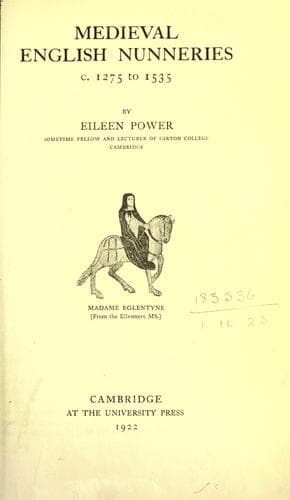
Medieval English Nunneries c. 1275 to 1535Power, Eileen
History
Medieval English Nunneries c. 1275 to 1535
Power, Eileen
Convents -- England; Monastic and religious life of women -- History
This practice of earmarking certain sources of income may be illustrated
from almost any monastic chartulary, for it was common for benefactors to
earmark donations of land and rent to certain special purposes, more
especially for the clothing of the nuns, for the support of the infirmary,
or for a special pittance from the kitchen[366]. Similarly bishops
appropriating churches to monastic houses sometimes set aside the proceeds
for special purposes[367]. The result of the practice was that the
obedientiaries of certain departments, more especially the cellaress,
chambress and sacrist, had to keep careful accounts of their receipts and
expenditure, which were submitted annually to the treasuress, when she was
making up her big account. Very few separate obedientiaries' accounts
survive for nunneries, partly because the majority were small and the
treasuress not infrequently acted as cellaress and did the general
catering herself. Cellaresses' accounts, however, survive for Syon and
Barking, chambresses' accounts for Syon and St Michael's Stamford (the
latter merely recording the payment to the nuns of their allowances) and
sacrists' accounts for Syon and Elstow[368]. In one column these accounts
set out the sources from which the office derives its income. This might
come to the obedientiary in one of two ways, either directly from the
churches, manors or rents appropriated to her, or by the hands of the
treasuress, who received and paid her the rents due to her office, or if
no revenues were appropriated to it, allocated her a lump sum out of the
general revenues of the house. Thus at Syon the cellaress drew her income
from the sale of hides, oxhides and fleeces (from slaughtered animals and
sheep at the farm), the sale of wood, and the profits of a dairy farm at
Isleworth, while the chambress simply answered for a sum of L10 paid to
her by the treasuresses. In another column the obedientiary would enter
her expenditure. This might take two forms. According to the Benedictine
rule and to the rule of the newly founded and strict Brigittine house of
Syon, all clothes and food were provided for the nuns by the chambress and
cellaress; and accordingly their accounts contain a complete picture of
the communal housekeeping. In the later middle ages, however, it became
the almost universal custom to pay the nuns a money allowance instead of
clothing, a practice which deprived the office of chambress of nearly all
its duties and possibly accounts for the rarity of chambresses' account
rolls. The Syon chambress' account is an example of the first or regular
method; the St Michael's, Stamford, account of the second. More rarely the
nuns received money allowances for a portion of their food. The growth of
this custom of paying money allowances will be described in a later
chapter[369]; here it will suffice to consider the housekeeping of a
nunnery in which that business was entirely in the hands of the chambress
and cellaress.
Public-domain text, read in full here on John Shaqi.
Reviews
Reviews
No reviews yet
Be the first to share your thoughts on this work.
Elsewhere in the archive
Join the Discussion
Join the discussion
Sign in to leave a comment or review.
Sign InorCreate an account