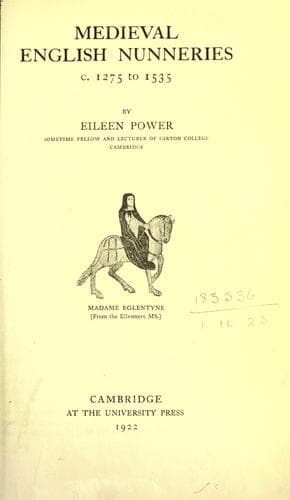
Medieval English Nunneries c. 1275 to 1535Power, Eileen
History
Medieval English Nunneries c. 1275 to 1535
Power, Eileen
Convents -- England; Monastic and religious life of women -- History
The cellaresses' accounts, which show us how the nun-housekeeper catered
for the community, are even more interesting than the chambresses'
accounts. The convent food was derived from two main sources, from the
home farm and from purchase. The home farm was usually under the
management of the cellaress and provided the house with the greater part
of its meat, bread, beer and vegetables, and with a certain amount of
dairy produce (butter, cheese, eggs, chickens). Anything which the farm
could not produce had to be bought, and in particular three important
articles of consumption, to wit the salt and dried fish eaten during the
winter and in Lent, the salt for the great annual meat-salting on St
Martin's day, and the spices and similar condiments used so freely in
medieval cooking and eaten by convents more especially in Lent, to relieve
the monotony of their fasting fare. The nuns of St Radegund's, Cambridge,
used to get most of their salt fish at Lynn, whence it was brought up by
river to Cambridge. From the accounts of 1449-51 it appears that the
senior ladies made the occasion one for a pleasant excursion. There is a
jovial entry in 1450-1 concerning the carriage by water from Lynn to
Cambridge of one barrel[372] and a half of white herrings, two cades[373]
of red herrings, two cades of smelts, one quarter of stockfish and one
piece of timber called "a Maste" out of which a ladder was to be made
(2_s._ 4_d._), together with the fares and food of Dame Joan Lancaster,
Dame Margaret Metham, Thomas Key (the bailiff) and Elene Herward of Lynn
to Cambridge (2_s._ 8_d._). Another entry displays to us Dame Joan
Lancaster bargaining for the smelts and the stockfish at Lynn. Fish was
usually bought from one John Ball of Lynn, who seems to have been a
general merchant of considerable custom, for the nuns also purchased from
him all the linen which they needed for towels and tablecloths, and some
trenchers. Occasionally, also, however, they purchased some of their fish
at one or other of the fairs held in the district; in 1449-50 they thus
bought 8 warp[374] of ling and 6 warp of cod from one John Antyll at Ely
fair and 14 warp of ling from the same man at Stourbridge fair, an
interesting illustration of how tradesmen travelled from fair to fair. At
St John Baptist's fair in the same year they bought a horse for 9_s._
6_d._, 2 qrs. 5 bushels of salt, some timber boards and three "pitcheforke
staves." In the following year they bought timber, pewter pots, a churn,
10 lbs. of soap and 3 lbs. of pepper at the famous fair of Stourbridge,
and salt and timber at the fair of St John Baptist. In 1481-2 they bought
salt fish, salt, iron nails, paper, parchment and "other necessities" at
the fairs of Stourbridge and of St Etheldreda the Virgin[375].
Public-domain text, read in full here on John Shaqi.
Reviews
Reviews
No reviews yet
Be the first to share your thoughts on this work.
Elsewhere in the archive
Join the Discussion
Join the discussion
Sign in to leave a comment or review.
Sign InorCreate an account