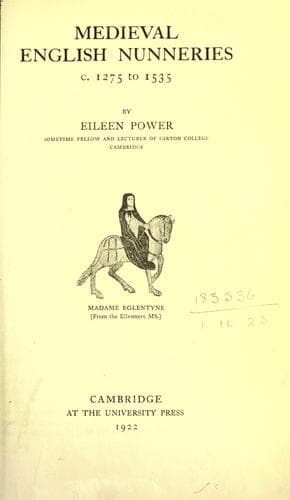
Medieval English Nunneries c. 1275 to 1535Power, Eileen
History
Medieval English Nunneries c. 1275 to 1535
Power, Eileen
Convents -- England; Monastic and religious life of women -- History
Evidence often crops up from a variety of sources concerning the relations
between the nuns and this important official. That these might be very
pleasant can well be imagined. Sometimes a bailiff of substance and
standing will place his daughter in the nunnery which he serves[408];
sometimes when he dies he will remember it in his will[409]. But all
bailiffs were not good and faithful servants. Mr Hamilton Thompson
considers that male stewards and bailiffs were often "responsible for the
financial straits to which the nunneries of the fifteenth century were
reduced, and ... certainly did much to waste the goods of the monasteries,
generally in their own interests"[410]. Such a man was Chaucer's Reeve,
though he did not waste land, for the reason that one does not kill the
goose that lays the golden eggs:
His lordes sheep, his neet, his dayerye,
His swyn, his hors, his stoor and his pultrye,
Was hoolly in this reves governing,
And by his covenaunt yaf the rekening....
His woning was ful fair upon an heeth,
With grene trees shadwed was his place.
He coude bettre than his lord purchace.
Ful riche he was astored prively,
His lord wel coude he plesen subtilly,
To yeve and lene him of his owne good,
And have a thank, and yet a cote and hood[411].
Several records of law-suits are extant, in which prioresses are obliged
to sue their bailiffs in the court of King's Bench for an account of their
periods of service[412], and visitation documents sometimes give a sorry
picture of the convent bailiff. The bailiff of Godstow (1432) went about
saying that there was no good woman in the nunnery[413]; the bailiff of
Legbourne (1440) persuaded the prioress to sell him a corrody in the house
and yet he "is not reckoned profitable to the house in that office, for
several of his kinsfolk are serving folk in the house, who look out for
themselves more than for the house"[414]; the bailiff of Redlingfield
(1427) was the prioress's lover[415].
Public-domain text, read in full here on John Shaqi.
Reviews
Reviews
No reviews yet
Be the first to share your thoughts on this work.
Elsewhere in the archive
Join the Discussion
Join the discussion
Sign in to leave a comment or review.
Sign InorCreate an account