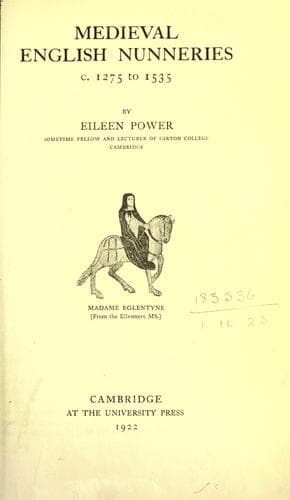
Medieval English Nunneries c. 1275 to 1535Power, Eileen
History
Medieval English Nunneries c. 1275 to 1535
Power, Eileen
Convents -- England; Monastic and religious life of women -- History
(2) _The administrative officials._ These varied in number with the size
of the house and the extent of its possessions. The chief administrative
official was the _steward_, who is not, however, found at all houses.
Sometimes the office of steward was complimentary and the fee attached was
nominal. The _Valor Ecclesiasticus_ shows that great men did not disdain
the post; Andrew Lord Windsor was steward of the Minoresses without
Aldgate, of Burnham and of Ankerwyke[395]. Henry Lord Daubeney was steward
of Shaftesbury[396], George Earl of Shrewsbury of Wilton[397], Henry
Marquess of Dorset of Nuneaton[398], Sir Thomas Wyatt of Malling[399], Sir
W. Percy of Hampole, Handale and Thicket[400], Lord Darcy of Swine[401],
the Earl of Derby of St Mary's Chester[402], and Mr Thomas Cromwell
himself of Syon and Catesby[403]. Some houses, such as Wilton, had more
than one steward, and Syon maintained stewards as well as bailiffs in most
of the counties in which it had land. Some of these great men were
obviously not working officials; but many of the houses maintained
stewards at a good salary, who superintended their business affairs, kept
the courts of their manors, and were sometimes lodged on the
premises[404]. The larger houses also paid one or more receivers and
rent-collectors and sometimes an auditor, but in the average house the
most important administrative official was the bailiff.
While large landowners kept bailiffs at each of the different manors which
they held, most nunneries employed a single bailiff, an invaluable
factotum who performed a great variety of business for them, besides
collecting rents from their tenants and superintending the home farm.
Thomas Key, the bailiff of St Radegund's Cambridge, 1449-51, is an active
person; he receives a stipend of 13_s._ 4_d._ per annum and an occasional
gift from the nuns; he rides about collecting their rents in
Cambridgeshire; he accompanies them to Lynn on the annual journey to buy
the winter stock of salt fish, or sometimes goes alone; he can turn his
hand to mending rakes and ladders (for which he gets 8_d._ for four days'
work), or to making the barley mows at harvest time, taking 3_d._ a day
for his pains; and indeed he is regularly hired to work during harvest, at
a fee of 6_s._ 8_d._ and two bushels of malt[405]. Often the bailiff's
wife was also employed by the nuns; the nuns of Sheppey paid their
bailiff, his wife and his servant all substantial salaries[406]. Some
nunneries had a lodging set apart for him in the convent buildings,
outside the nuns' cloister[407].
Public-domain text, read in full here on John Shaqi.
Reviews
Reviews
No reviews yet
Be the first to share your thoughts on this work.
Elsewhere in the archive
Join the Discussion
Join the discussion
Sign in to leave a comment or review.
Sign InorCreate an account