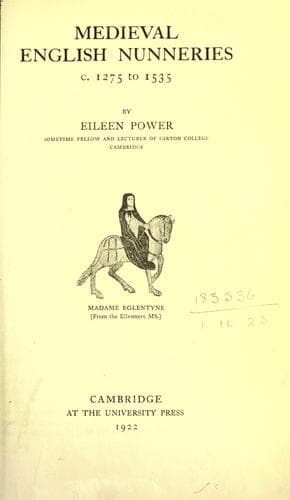
Medieval English Nunneries c. 1275 to 1535Power, Eileen
History
Medieval English Nunneries c. 1275 to 1535
Power, Eileen
Convents -- England; Monastic and religious life of women -- History
It will thus be seen that the size of a convent household might vary
considerably. The twenty-six nuns of St Mary's Winchester had gathered
round themselves a large household of nine women servants, five male
chaplains and twenty male officers and servants; but they boarded and
educated twenty-six children, gave three corrodies and supported thirteen
poor sisters (who may however have done some of the work of the house).
The twelve nuns of St Radegund's lived more economically, with three male
and four female servants and six hinds, besides the chaplains; but even
their household seems a sufficiently large one. The ten nuns of Whitney
Priory employed two priests, a waiting maid for the prioress, nine other
women servants and thirteen hinds[421]. It is notable that the maintenance
of a larger household than the revenues of the house could support is not
infrequently censured in injunctions as responsible for its financial
straits. At Nuncoton in 1440 the Prioress said that the house employed
more women servants than was necessary[422] and a century later Bishop
Longland spoke very sternly against the same fault:
that ye streight upon sight herof dymynishe the nombre of your
seruants, as well men as women, which excessyve nombre that ye kepe of
them bothe is oon of the grette causes of your miserable pouertye and
that ye are nott hable to mayntene your houshold nouther reparacons of
the same, by reason whereof all falleth to ruyne and extreme decaye.
And therefore to kepe noo moo thenne shalbe urged necessarye for your
said house[423].
On the other hand many nunneries could by no means be charged with keeping
up an excessive household. Rusper, which had leased all its demesnes, had
only two women servants in its employ at the Dissolution[424], and nuns
sometimes complained to their visitors that they were too poor to keep
servants and had to do the work of the house themselves, to the detriment
of their religious duties in the choir. At Ankerwyke one of the nuns
deposed that
they had not serving folk in the brewhouse, bakehouse or kitchen from
the last festival of the Nativity of St John the Baptist last year to
the Michaelmas next following, in so much that this deponent, with the
aid of other her sisters, prepared the beer and victuals and served
the nuns with them in her own person.
Public-domain text, read in full here on John Shaqi.
Reviews
Reviews
No reviews yet
Be the first to share your thoughts on this work.
Elsewhere in the archive
Join the Discussion
Join the discussion
Sign in to leave a comment or review.
Sign InorCreate an account