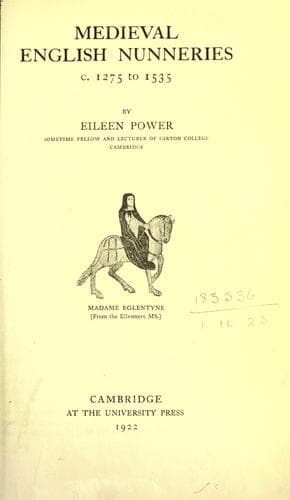
Medieval English Nunneries c. 1275 to 1535Power, Eileen
History
Medieval English Nunneries c. 1275 to 1535
Power, Eileen
Convents -- England; Monastic and religious life of women -- History
At Gracedieu there was no servant for the infirmary and the subcellaress
had to sleep there and look after the sick, so that she could not come to
matins. At Markyate and Harrold the nuns had no washerwoman; at the former
house it was said "that the nuns have no woman to wash their clothes and
to prepare their food, wherefore they are either obliged to be absent from
divine service or else to think the whole time about getting these things
ready"; at the latter a nun said "that they have no common washerwoman to
wash the clothes of the nuns, save four times a year, and at other times
the nuns are obliged to go to the bank of the public stream to wash their
clothes"[425]. It was probably on account of the poverty of Sinningthwaite
that Archbishop Lee ordered "the susters and the nonys there [that] they
kepe no seculer women to serve them or doe any busynes for them, but yf
sekenes or oder necessitie doe require"[426].
As to the relations between the servants and their mistresses both
visitation reports and account rolls sometimes give meagre scraps of
information, which only whet the appetite for more. The payment of the
servants was partly in money, partly in board or in allowances of food,
partly in livery; stock-inventories constantly make mention of allowances
of wheat, peas, oats or oatmeal and maslin (a mixture of wheat and rye)
paid to this or that servant, and account rolls as constantly mention a
livery, a pair of hose, a pair of shoes, or the money equivalent of these
things, as forming part of the wage. The more important agricultural
servants had also sometimes the right to graze a cow, or a certain number
of sheep on the convent's pastures. Some servants, however, received wages
without board, others wages without livery. Account rolls seem to bear
witness to pleasant relations; there is constant mention of small tips or
presents to the servants and of dinners made to them on great occasions.
This was Merry England, when the ploughman's feasts enlivened his hard
work and comfortless existence; he must have his Shrovetide pancakes, his
sheep-shearing feast, his "sickle goose" or harvest-home, and his
Christmas dinner; and the household servants must as often as may be have
a share in the convent pittance. The very general custom of allowing the
female servants to sleep in the dorter (against which bishops were
continually having to make injunctions) must have made for free and easy
and close relations between the nuns and the secular women who served
them; and sometimes one of these would save up and buy herself a corrody
in the house to end her days[427]. Occasionally these close relations led
to difficulties; a trusted maid would gain undue influence over the
prioress and the nuns would be jealous of her. Thus at Heynings in 1440 it
was complained that the prioress "encourages her secular serving women,
whom she believes more than her sisters in their words, to scold the same
her sisters"[428].
Public-domain text, read in full here on John Shaqi.
Reviews
Reviews
No reviews yet
Be the first to share your thoughts on this work.
Elsewhere in the archive
Join the Discussion
Join the discussion
Sign in to leave a comment or review.
Sign InorCreate an account