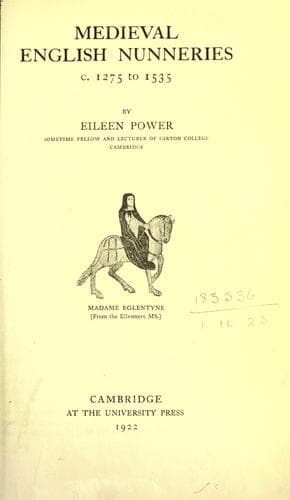
Medieval English Nunneries c. 1275 to 1535Power, Eileen
History
Medieval English Nunneries c. 1275 to 1535
Power, Eileen
Convents -- England; Monastic and religious life of women -- History
for providing a variety of iron implements and _cart-clowtes_, for shoeing
the horses and for mending the ploughshares, and for "blooding the horses
on St Stephen's day" (Dec. 26), to Thomas Boltesham, _cowper_, for mending
wooden utensils, to Thomas Speed for helping in the kitchen on fair-day
and to John Speed for working in the garden. Besides these they hire
various day-labourers to work in the fields during the sowing season,
hay-making and harvest, or to lop trees round the convent and hew up
firewood, or to prune and tie up the vines (for there were English
vineyards in those days). Then there is a long list of carpenters,
builders, thatchers, and plumbers engaged in making and repairing the
buildings of the convent and its tenants. Finally there are the various
cloth workers, spinners, weaver, fuller, shearman, dyer and tailor hired
to make the servants' clothes, concerning whom something has already been
said[438].
Thus many persons came to depend upon a nunnery for part of their
livelihood, who were not the permanent servants of the house, and this
goes further than any imagined reverence for the lives and calling of
their inmates to explain the anxiety shown in some places for the
preservation of nunneries when the day of dissolution came. The convents
were not only inns and boarding-houses for ladies of the upper class and
occasionally schools for their daughters; they were the great employers
and consumers of their districts, and though their places must sooner or
later be taken by other employers and consumers, yet at the moment many a
husbandman and artificer must have seen his livelihood about to slip away
from him. The nuns of Sheppey, in their distant and lonely flats, clearly
employed a whole village[439]. They could not count on hiring carpenter
and thatcher for piece-work when they wanted them in that thinly populated
spot, so they must hire them all the year round. Twenty-six hinds and
seven women they had in all, working in their domestic offices or on the
wide demesne, most of which they farmed themselves, for food was far to
buy if they did not grow it. Three shepherds kept their large flock, a
cowherd drove their kine and hogs, a horse-keeper looked to their 17
horses. All the other men and women were busy with the beasts and the
crops in the field, or with work in the brew house, the "bultyng howse,"
the bakehouse and the dairy. So also at the abbey of Polesworth, where
fifteen nuns employed in all thirty-eight persons, women servants, yeomen
about the household and hinds. "In the towne of Pollesworth," said the
commissioners, who were gentlemen of the district and not minded to lose
the house:
Public-domain text, read in full here on John Shaqi.
Reviews
Reviews
No reviews yet
Be the first to share your thoughts on this work.
Elsewhere in the archive
Join the Discussion
Join the discussion
Sign in to leave a comment or review.
Sign InorCreate an account