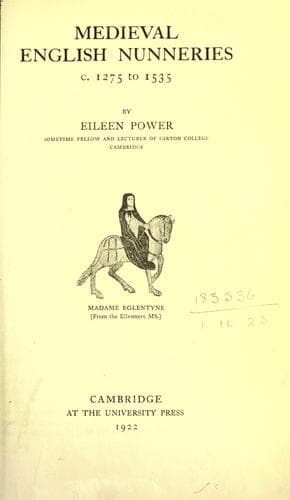
Medieval English Nunneries c. 1275 to 1535Power, Eileen
History
Medieval English Nunneries c. 1275 to 1535
Power, Eileen
Convents -- England; Monastic and religious life of women -- History
the secular women servants of the nuns are wont too often to come into
the frater, at times when the nuns are eating there, and into the
cloister while the nuns are engaged there in chapter meetings,
contemplation, reading or praying, and there do make a noise and
behave otherwise ill, in a way which beseems not the honesty of
religion. And these secular women often keep up their chattering,
carolling (_cantalenas_) and other light behaviour, until the middle
of the night, and disturb the aforesaid nuns, so that they cannot
properly perform the regular services. Wherefore we ... command you
that you henceforth permit not the aforesaid things, nor any other
things which befit not the observances of your rule, to be done by the
said servants or by others, and that you permit not these servants to
serve you henceforth in the frater, and a servant or any other secular
person who does the contrary shall be expelled from the monastery.
Moreover we forbid on pain of the greater excommunication that any
servants defamed for any offence be henceforth admitted to dwell among
you, or having been admitted, be retained in your service, for from
such grave scandals may arise concerning you and your house[437].
We have spoken hitherto about the regular hired servants of the house; but
it must not be forgotten that nuns normally had a larger community
dependent in part upon them. From time to time they were wont to hire such
additional labour as they required, whether servants in husbandry taken on
for the haymaking and harvest season, artificers hired to put up or repair
buildings, workers in various branches of the cloth industry to make the
liveries of the servants, itinerant candle-makers to prepare the winter
dips, or a variety of casual workers hired at one time or another for
specific purposes. The nuns of St Radegund's, Cambridge, entered in their
accounts a large number of payments besides those to their regular
servants. In moments of stress they were wont to fall back upon a paragon
named Katherine Rolf. We first meet her in 1449-50 weeding the garden for
four days, for the modest sum of 4-1/2_d._; but soon afterwards behold her
on the roof, aiding the thatchers to thatch two tenements, at 1-1/2_d._ a
day for twelve days. In the next year she is more active still; first of
all she is found helping the candle-makers to make up 14 lbs. of tallow
candles for the guest-house. Then she combs and cleans a pound of wool for
spinning. Then she appears in the granary helping the maltster to thresh
and winnow grain. In the midst of these activities she turns an honest
penny by selling fat chickens to the convent. The nuns also disburse small
sums of money to the man who cleanses the convent privies, to the
_slawterman_ for killing beasts for the kitchen, to Richard Gardyner for
beating stockfish, to Thomas Osborne for making malt, to Thomas the Smith
Public-domain text, read in full here on John Shaqi.
Reviews
Reviews
No reviews yet
Be the first to share your thoughts on this work.
Elsewhere in the archive
Join the Discussion
Join the discussion
Sign in to leave a comment or review.
Sign InorCreate an account