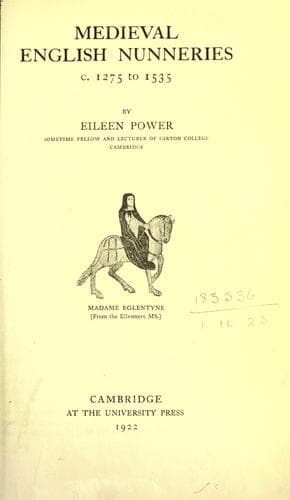
Medieval English Nunneries c. 1275 to 1535Power, Eileen
History
Medieval English Nunneries c. 1275 to 1535
Power, Eileen
Convents -- England; Monastic and religious life of women -- History
In the history of the medieval nunneries of England there is nothing more
striking than the constant financial straits to which they were reduced.
Professor Savine's analysis of the _Valor Ecclesiasticus_ has shown that
in 1535 the nunneries were on an average only half as rich as the men's
houses, while the average number of religious persons in them was
larger[442]; and yet it is clear from the evidence of visitation documents
that even the men's houses were continually in debt. It is therefore not
to be wondered at that there was hardly a nunnery in England, which did
not at one time or another complain of poverty. These financial
difficulties had already begun before the end of the thirteenth century
and they grew steadily worse until the moment of the Dissolution. The
worst sufferers of all were the nunneries of Yorkshire and the North, a
prey to the inroads of the Scots, who time after time pillaged their lands
and sometimes dispersed their inmates; Yorkshire was full of nunneries and
almost all of them were miserably poor. But in other parts of the country,
without any such special cause, the position was little better. When
Bishop Alnwick visited the diocese of Lincoln in the first half of the
fifteenth century, fourteen out of the twenty-five houses which he
examined were in financial difficulties. Moreover not only is this true of
small houses, inadequately endowed from their foundation and less likely
to weather bad times, but the largest and richest houses frequently
complained of insufficient means. It is easy to understand the distress of
the poor nuns of Rothwell; their founder Richard, Earl of Gloucester, had
died before properly endowing the house, and the prioress and convent
could expend for their food and clothing only four marks and the produce
of four fields of land, in one of which the house was situated[443]. But
it is less easy to account for the constant straits of the great Abbey of
Shaftesbury, which had such vast endowments that a popular saying had
arisen: "If the Abbot of Glastonbury could marry the Abbess of
Shaftesbury, their heir would hold more land than the King of
England"[444]. It is comprehensible that the small houses of Lincolnshire
and the dangerously situated houses of Yorkshire should be in
difficulties; but their complaints are not more piteous than those of
Romsey, Godstow and Barking, richly endowed nunneries, to which the
greatest ladies of the land did not disdain to retire.
Public-domain text, read in full here on John Shaqi.
Reviews
Reviews
No reviews yet
Be the first to share your thoughts on this work.
Elsewhere in the archive
Join the Discussion
Join the discussion
Sign in to leave a comment or review.
Sign InorCreate an account