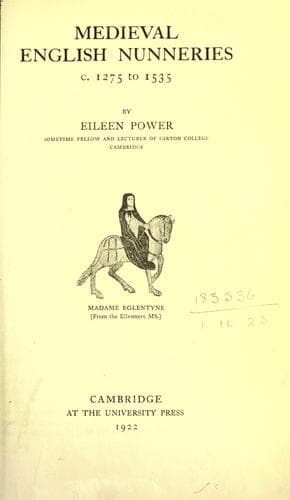
Medieval English Nunneries c. 1275 to 1535Power, Eileen
History
Medieval English Nunneries c. 1275 to 1535
Power, Eileen
Convents -- England; Monastic and religious life of women -- History
The poverty of the nunneries was manifested in many ways. One of these was
the extreme prevalence of debt. On the occasion of Bishop Alnwick's
visitations, to which reference has been made above, no less than eleven
houses were found to be in debt[445]. At Ankerwyke the debts amounted to
L40, at Langley to L50, at Stixwould to 80 marks, at Harrold to 20 marks,
at Rothwell to 6 marks. Markyate was "indebted to divers creditors for a
great sum." Heynings was in debt owing to costly repairs and to several
bad harvests, and about the same time a petition from the nuns stated that
they had "mortgaged for no short time their possessions and rents and thus
remain irrecoverably pledged, have incurred various very heavy debts and
are much depressed and brought to great and manifest poverty"[446]. In
some cases the prioresses claimed to have reduced an initial debt; the
Prioress of St Michael's, Stamford, said that on her installation twelve
years previously the debts stood at L20 and that they were now only 20
marks; the Prioress of Gracedieu said that she had reduced debts from L48
to L38; the Prioress of Legbourne said that the debts were now only L14
instead of L63[447]. But from the miserable poverty of some of these
houses (for instance Gokewell, where the income in rents was said to be
L10 yearly and Langley, where it was L20, less than half the amount of the
debts) it may be inferred that the struggle to repay creditors out of an
already insufficient income was a hopeless one; and the effort to do so
out of capital was often more disastrous still. Nothing is more striking
than the lists of debts which figure in the account rolls of medieval
nunneries. In thirteen out of seventeen account rolls belonging to St
Michael's Stamford[448] and ranging between 1304 and 1410, the nuns end
the year with a deficit; and in fourteen cases there is a schedule of
debts added to the account. Sometimes the amount owed is small, but
occasionally it is very large. In the first roll which has survived
(1304-5) the deficit on the account is some L5 odd; the debts are entered
as L23. 1_s._ 11_d._ on the present year (which were apparently afterwards
paid, because the items were marked "vacat pour ceo ke le deners sount
paye") and fifteen items amounting to L52. 3_s._ 8_d._ and described as
"nos auncienes dettes estre cest aan"; in fact the debts amount to
considerably more than the income entered in the roll[449]. Similarly in
1346-47 the debts amount to L51 odd and in 1376-77 to L53 odd, and in
other years to smaller sums. In some cases a list of debts due to the
convent is also entered in the account, but in only four of these does the
money owed to the house exceed the amount owing by it; and "argent
aprompte" or "money borrowed" is a regular item in the credit account.
Similarly the treasuresses' accounts of Gracedieu end with long schedules
of debts due by the house[450]. Nor was it only the small houses which got
into debt.
Public-domain text, read in full here on John Shaqi.
Reviews
Reviews
No reviews yet
Be the first to share your thoughts on this work.
Elsewhere in the archive
Join the Discussion
Join the discussion
Sign in to leave a comment or review.
Sign InorCreate an account