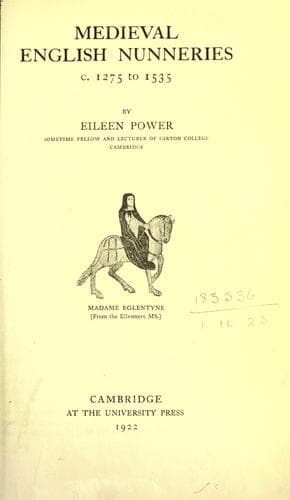
Medieval English Nunneries c. 1275 to 1535Power, Eileen
History
Medieval English Nunneries c. 1275 to 1535
Power, Eileen
Convents -- England; Monastic and religious life of women -- History
Tarrant Keynes was quite well off, but as early as 1292 the
nuns asked the royal leave to sell forty oaks to pay their debts[451].
Godstow was rich, but in 1316 the King had to take it under his protection
and appoint keepers to discharge its debts, "on account of its poverty and
miserable state," and in 1335 the profits during vacancy were remitted to
the convent by the King "because of its poverty and misfortunes"[452]. St
Mary's, Winchester, was a famous house, but it also was in debt early in
the fourteenth century[453]. It should be noticed that the last cases (and
that of St Michael's Stamford, 1304-5) are anterior to the Black Death, to
whose account it has been customary to lay all the financial misfortunes
of the religious houses. It is undeniable that the Black Death completed
the ruin of many of the smaller houses, and that matters grew steadily
worse during the last half of the fourteenth and throughout the fifteenth
century; but there is ample evidence that the finances of many religious
houses, both of men and of women, had been in an unsatisfactory condition
at an earlier date; and even the golden thirteenth century can show cases
of heavy debt[454].
In the smaller houses the constant struggle with poverty must have
entailed no little degree of discomfort and discouragement. Sometimes the
nuns seem actually to have lacked food and clothes, and it seems clear
that in many cases the revenues of these convents were insufficient for
their support and that they were dependent upon the charity of friends. A
typical case is that of Legbourne, where one of the nuns informed Bishop
Alnwick (1440) that since the revenues of the house did not exceed L40 and
since there were thirteen nuns and one novice, it was impossible for so
many of them to have sufficient food and clothing from such inadequate
rents, unless they received assistance from secular friends[455]. Fosse
in 1341 was said to be so slenderly endowed that the nuns had not enough
to live on without external aid[456]; and in 1440 Alnwick noted "all the
nuns complain ever of the poverty of the house and they receive nothing
from it save only food and drink"[457]. Of Buckland it was stated that
"its possessions cannot suffice for the sustenance of the said sisters
with their household, for the emendation of their building, for their
clothes and for their other necessities without the help of friends and
the offering of alms"[458]. Cokehill in 1336 was excused a tax because it
was so inadequately endowed that the nuns had not enough to live upon
without outside aid[459]. Davington in 1344 was in the same position;
although the nuns were reduced to half their former number, they could not
live upon their revenues without the charity of friends[460]. Alnwick's
visitations, indeed, show quite clearly that in poor houses the nuns were
often expected to provide either clothes or (on certain days) food for
themselves, out of the gift of their friends[461]. At Sinningthwaite, in
Public-domain text, read in full here on John Shaqi.
Reviews
Reviews
No reviews yet
Be the first to share your thoughts on this work.
Elsewhere in the archive
Join the Discussion
Join the discussion
Sign in to leave a comment or review.
Sign InorCreate an account