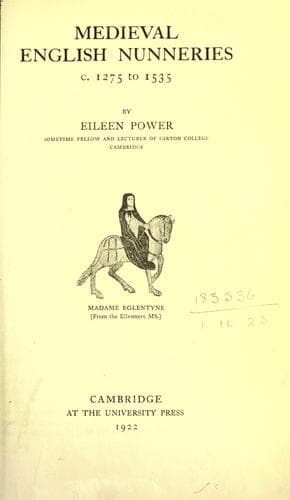
Medieval English Nunneries c. 1275 to 1535Power, Eileen
History
Medieval English Nunneries c. 1275 to 1535
Power, Eileen
Convents -- England; Monastic and religious life of women -- History
apparently lost their granaries in 1311, for they sought licence to beg on
the ground that their houses and corn had been consumed by fire, and in
1459 they asked for a similar licence, because their buildings had been
burnt, and their land inundated[496]. The convent of St Bartholomew's,
Newcastle, gave misfortune by fire as one reason for wishing to
appropriate the hospital or chapel of St Edmund the King in
Gateshead[497].
Sometimes poverty, misfortune and mismanagement reduced the nuns to
begging alms. About 1253 the convent of St Mary of Chester wrote to Queen
Eleanor, begging her to confirm the election of a prioress "to our
miserable convent amidst its multiplied desolations; for so greatly are we
reduced that we are compelled every day to beg abroad our food, slight as
it is"[498]. Similarly the starving nuns of Whitehall, Ilchester, were
reduced to "begging miserably," after the _regime_ of a wicked prioress
at the beginning of the fourteenth century[499]. In 1308 the subprioress
and convent of Whiston mentioned, in asking for permission to elect Alice
de la Flagge, that the smallness of their possessions had compelled the
nuns formerly to beg, "to the scandal of womanhood and the discredit of
religion"[500]. In 1351 Bishop Edyndon of Winchester "counted it a
merciful thing," to come to the assistance of the great Abbeys of Romsey
and St Mary's Winchester, "when overwhelmed with poverty, and when in
these days of increasing illdoing and social deterioration they were
brought to the necessity of secret begging"[501]. At Cheshunt in 1367 the
nuns declared that they often had to beg in the highways[502]. At Rothwell
in 1392 the extreme poverty of the nuns compelled some of them "to incur
the opprobrium of mendicity and beg alms after the fashion of the
mendicant friars"[503]. In all these cases it is evident that objection
was taken to personal begging by the nuns, and it is clear that such a
practice, which took the nuns out into the streets and into private
houses, was likely to be subversive of discipline. The custom of begging
through a proctor was open to no such objection; and it was common for
bishops to give to the poorer houses licences, allowing them to collect
alms in this manner. Early in the fifteenth century the nuns of Rowney in
Hertfordshire petitioned the Chancellor for letters patent for a proctor
to go about the country and collect alms for them, and their request was
granted[504]. Many such licences to beg occur in episcopal registers;
Bishop Dalderby of Lincoln granted them to Little Marlow (1300 and
1311)[505], St Leonard's Grimsby (1311)[506], and Rothwell (1318)[507];
and St Michael's Stamford (1359) and Sewardsley (1366) received similar
licences from his successors[508]. The distinction between begging by the
nuns and begging by a proctor is clearly drawn in the licence granted by
Bishop Dalderby to Rothwell. Addressing the clergy in the Archidiaconates
of Northampton and Buckingham he writes:
Public-domain text, read in full here on John Shaqi.
Reviews
Reviews
No reviews yet
Be the first to share your thoughts on this work.
Elsewhere in the archive
Join the Discussion
Join the discussion
Sign in to leave a comment or review.
Sign InorCreate an account