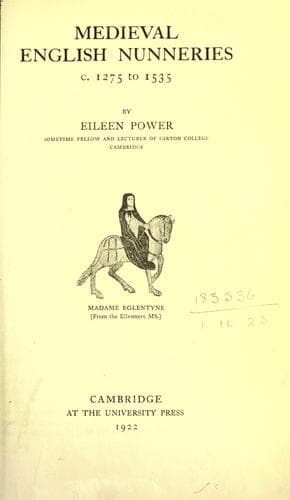
Medieval English Nunneries c. 1275 to 1535Power, Eileen
History
Medieval English Nunneries c. 1275 to 1535
Power, Eileen
Convents -- England; Monastic and religious life of women -- History
Pitying, with paternal affection, the want of the poor nuns of
Rothwell in our diocese, who are oppressed by such scarcity that they
are obliged to beg the necessities of life, we command and straitly
enjoin you, that when there shall come to you suitable and honest
secular proctors or messengers of the same nuns (not the nuns
themselves, that they may have no occasion for wandering thereby), to
seek and receive the alms of the faithful for their necessities, ye
shall receive them kindly and expound the cause of the said nuns to
the people in your churches, on Sundays, and feast days during the
solemnisation of mass, and promote the same by precept and by example
once every year for the next three years, delivering the whole of
whatever shall be collected to these proctors and messengers[509].
The Bishops sought to relieve necessitous convents by offering particular
inducements to the faithful to give alms, when they were thus requested.
Along with mending roads and bridges, ransoming captives, dowering poor
maidens, building churches and endowing hospitals, the assistance of
impecunious nunneries was generally recognised as a work of Christian
charity, and indulgences were often offered to those who would aid a
particular house[510]. The same Bishop Dalderby, for instance, granted
indulgences for the assistance of Cheshunt, Flamstead[511], Sewardsley,
Catesby, Delapre[512], Ivinghoe[513], Fosse[514], St James' outside
Huntingdon and St Radegund's, Cambridge[515]. Archbishop Kemp of York
granted an indulgence of a hundred days valid for two years to all who
should assist towards the repair of Arden (1440) and of Esholt (1445), and
Archbishop William Booth (1456) granted an indulgence of forty days to
penitents contributing to the repair of Yedingham[516]; indeed it is
probable that the money for the much needed work of roofing a building
could be collected only by means of such special appeals. The Popes also
sometimes granted indulgences; Boniface IX did so to penitents who on the
feasts of dedication visited and gave alms towards the conservation of the
churches and priories of Wilberfoss, St Clement's, York, and Handale[517].
The history of St Radegund's, Cambridge, will serve to illustrate the
method by which the Church thus organised the work of poor-relief in the
middle ages; and it will be noticed that this nunnery was an object of
care to Bishops of other dioceses beside that of Ely[518]. In 1254 Walter
de Suffield, Bishop of Norwich, granted a relaxation of penance for
twenty-five days to persons contributing to the aid of the nuns; in 1268
Richard de Gravesend, Bishop of Lincoln, ordered collections to be made in
the churches of the Archidiaconates of Northampton and Huntingdon on their
behalf; in 1277 Roger de Skerning, Bishop of Norwich, ordered collections
to be made in his diocese for the repair of the church; in 1313 the
Public-domain text, read in full here on John Shaqi.
Reviews
Reviews
No reviews yet
Be the first to share your thoughts on this work.
Elsewhere in the archive