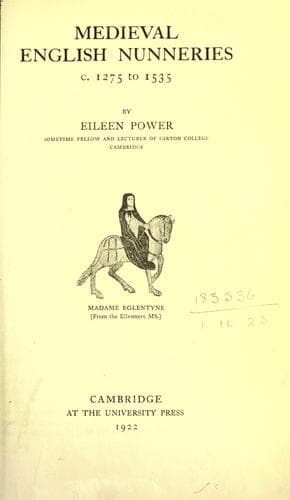
Medieval English Nunneries c. 1275 to 1535Power, Eileen
History
Medieval English Nunneries c. 1275 to 1535
Power, Eileen
Convents -- England; Monastic and religious life of women -- History
Official of the Archdeacon of Ely wrote to the parochial clergy of the
diocese recommending the nuns to them as objects of charity, having lost
their house and goods by fire, and in the same year Bishop Dalderby
granted an indulgence on their behalf for this reason[519]; while in 1314
John de Ketene, Bishop of Ely, confirmed the grants of indulgence made by
his brother bishops to persons contributing to their relief and to the
rebuilding of the house. The next indulgence mentioned is one of forty
days granted by Thomas Arundel, Bishop of Ely, in 1376, also on the
occasion of a fire; in 1389 Bishop Fordham of Ely granted another forty
days indulgence for the repair of the church and cloister and for the
relief of the nuns[520], and in 1390 William Courtenay, Archbishop of
Canterbury, made a similar grant, mentioning that the buildings had been
ruined by violent storms; finally in 1457 Bishop Grey of Ely granted a
forty days indulgence for the repair of the bell-tower and for the
maintenance of books, vestments and other church ornaments[521]. There is
no need to suppose that St Radegund's was in any way a particularly
favoured house; and such a list of grants shows that the Church fulfilled
conscientiously the duty of organising poor-relief and that the objects
for which indulgences were granted were not always as unworthy as has
sometimes been supposed[522].
The financial straits to which the smaller convents were continually and
the greater convents sometimes reduced grew out of a number of causes; and
it is interesting to inquire what brought the nuns to debt or to begging
and why they were so often in difficulties. A study of monastic documents
makes it clear that a great deal of this poverty was in no sense the fault
of the nuns. Apart from obvious cases of insufficient endowment, the
medieval monasteries suffered from natural disasters, which were the lot
of all men, and from certain exactions at the hands of men, which fell
exclusively upon themselves. Of natural disasters the frequency of fires
has already been mentioned. Another danger, from which houses situated in
low lying land near a river or the sea were never free, was that of
floods. The inundation of their lands was declared one of the reasons for
appropriating the church of Bradford-on-Avon to Shaftesbury in 1343; and
in 1380 the nuns were allowed to appropriate another church, in
consideration of damage done to their lands by encroachments of the sea
and losses of sheep and cattle[523]. In 1377 Barking suffered the
devastation by flood of a large part of its possessions along the Thames
and never recovered its former prosperity[524]; and in 1394 Bishop
Fordham of Ely granted an indulgence for the nuns of Ankerwyke, whose
goods had been destroyed by floods[525]. In the north the lands of St
Leonard's, Grimsby, were flooded in 1459[526]; in 1445 the nuns of Esholt
suffered heavy losses from the flooding of their lands near the river
Public-domain text, read in full here on John Shaqi.
Reviews
Reviews
No reviews yet
Be the first to share your thoughts on this work.
Elsewhere in the archive
Join the Discussion
Join the discussion
Sign in to leave a comment or review.
Sign InorCreate an account