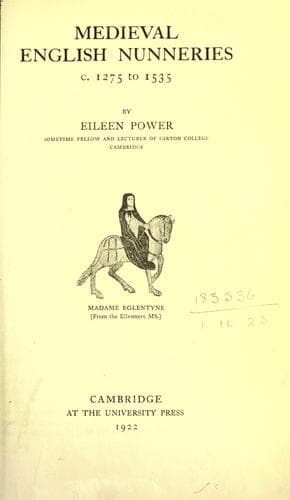
Medieval English Nunneries c. 1275 to 1535Power, Eileen
History
Medieval English Nunneries c. 1275 to 1535
Power, Eileen
Convents -- England; Monastic and religious life of women -- History
These natural disasters could not but have an adverse effect upon the
fortunes of the monastic houses; and many charters and petitions contain
clauses which specifically attribute the distress of this or that nunnery
to one of the three causes described above. During the famine years of
1314-5 Walter Reynolds, Archbishop of Canterbury, wrote to the Bishop of
Winchester, urging him to take some steps for the relief of the nuns of
Wintney, who were dispersing themselves in the world, because no proper
provision was made for their food[538], and about the same time the
convent of Clerkenwell addressed a petition to Queen Isabel, stating that
they were "moet enpouerees par les durs annez" and begging her to procure
for them the King's leave to accept certain lands and rents to the value
of twenty pounds[539]. In 1326 (after the great drought) the nuns of
King's Mead, Derby, begged the King to take them under his special
protection, granting the custody of the house to two _custodes_, on the
ground that, owing to the badness of past years and the unusually heavy
mortality among cattle their revenues were reduced and they were unable to
meet the claims made by guests upon their hospitality[540]. The ravages of
the Black Death were most severe of all and many houses never recovered
from it[541]. In the diocese of Lincoln the nunnery of Wothorpe lost all
its members save one, whom the Bishop made Prioress; and in 1354 it was
annexed to St Michael's Stamford[542]. Greenfield Priory, when he visited
it in 1350, "per tres menses stetit et stat priorisse solacio
destituta"[543]; and other houses in this large diocese which lost their
heads were Fosse, Markyate, Hinchinbrooke, Gracedieu, Rothwell, Delapre,
Catesby, Sewardsley, Littlemore and Godstow[544]. In the diocese of York
the prioresses of Arthington, Kirklees, Wallingwells and St Stephen's
Foukeholm died; the latter house, like Wothorpe, failed to recover and is
never heard of again[545]. Other parts of the country suffered in the same
way. At Malling Abbey in Kent the Bishop made two abbesses in succession,
but both died and only four professed nuns and four novices remained, to
one of whom the Bishop committed the custody of the temporalities and to
another that of the spiritualities, because there was no fit person to be
made Abbess[546]. At Henwood, in August 1349, there was no Prioress, "and
of the fifteen nuns who were lately there, three only remain"[547].
Public-domain text, read in full here on John Shaqi.
Reviews
Reviews
No reviews yet
Be the first to share your thoughts on this work.
Elsewhere in the archive
Join the Discussion
Join the discussion
Sign in to leave a comment or review.
Sign InorCreate an account