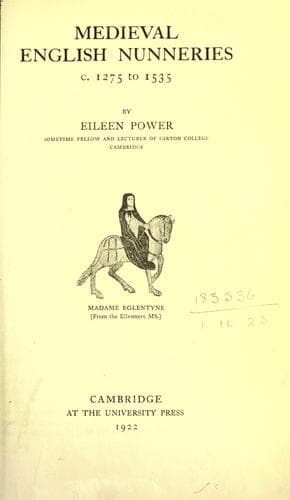
Medieval English Nunneries c. 1275 to 1535Power, Eileen
History
Medieval English Nunneries c. 1275 to 1535
Power, Eileen
Convents -- England; Monastic and religious life of women -- History
The revenues of the nunneries, often scant to begin with and liable to
constant diminution from the ravages of nature, were still more heavily
burdened by a variety of exactions on the part of the authorities of
Church and State. The procurations payable to the Bishop on his visitation
fell heavily upon the smaller houses; hence such a notice as that which
occurs in Bishop Nykke's Register under the year 1520: "Item the reverend
father with his colleagues came down to the house of nuns that afternoon,
and having seen the priory he dissolved his visitation there, on account
of the poverty of the house"[560]. St Mary Magdalen's, Bristol, was on
account of its poverty exempt from the payment of such procurations[561]
and the Bishops doubtless often exercised their charity upon such
occasions[562]. Papal exactions were even more oppressive; John of
Pontoise, Bishop of Winchester, pleaded with the papal nuncio in 1285 that
he would forbear to exact procurations from the poor nuns of Wintney, whom
the Bishop himself excused from all charges in view of their deep
poverty[563]; and in 1300 Bishop Swinfield of Hereford made a similar
appeal to the commissary of the nuncio, and secured the remission of
procurations due from the nuns of Lingbrook and the relaxation of the
sentence of excommunication, which they had incurred through
non-payment[564]. The obligation to pay tithes also fell heavily upon the
poorer houses; it was for this reason that Archbishop John le Romeyn
appealed to the Prior of Newburgh in 1286 not to exact tithes from the
food of animals in Nether Sutton, belonging to the poor nuns of
Arden[565]; and in 1301 the Prior of Worcester desired his commissary to
spare the poverty of the nuns of Westwood and not to exact tithes or any
other things due to him from them or from their churches[566]. Added to
ecclesiastical exactions were the taxes due to the Crown. In 1344 the nuns
of Davington addressed a petition to Edward III, representing that, owing
to their great poverty, they were unable to satisfy the King's public aids
without depriving themselves of their necessary subsistence, a plea which
was found to be true[567]. The frequency with which such petitions for
exemption from the payment of taxes were made and granted, is in itself a
proof that the burden of taxation was a real one, for the Crown would not
have excused its dues, unless the need for such an act of charity had been
great[568]; and it is obvious that the sheer impossibility of collecting
the money from a poverty-stricken house must often have left little
alternative. The houses that did contribute were not slow to complain.
"The unwonted exactions and tallages with which their house and the whole
of the English Church has been burdened" were pleaded by the nuns of
Heynings as in part responsible for their poverty in 1401[569]; similarly
"the necessary and very costly exactions of tenths and other taxes and
Public-domain text, read in full here on John Shaqi.
Reviews
Reviews
No reviews yet
Be the first to share your thoughts on this work.
Elsewhere in the archive
Join the Discussion
Join the discussion
Sign in to leave a comment or review.
Sign InorCreate an account