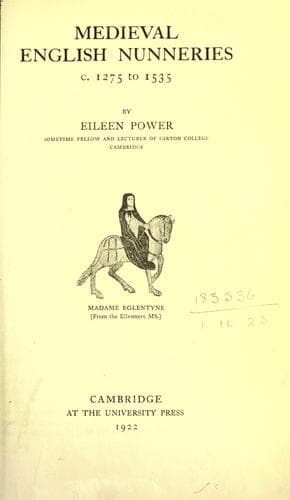
Medieval English Nunneries c. 1275 to 1535Power, Eileen
History
Medieval English Nunneries c. 1275 to 1535
Power, Eileen
Convents -- England; Monastic and religious life of women -- History
unsupportable burdens" occurs in a complaint by Romsey in 1351; and the
Abbess and Convent of St Mary's, Winchester, stated in 1468, that they
were so burdened with the repair of their buildings and with the payment
of imposts, that they could not fulfil the obligations of their order as
to hospitality[570].
Nor was taxation for public purposes the only demand made upon the
religious houses. Abbeys holding of the King in chief had to perform many
services appertaining to tenants in chief, which seem oddly incongruous in
the case of nunneries. The Abbesses of Shaftesbury, St Mary's Winchester,
Wilton and Barking, were baronesses in their own right; the privilege of
being summoned to parliament was omitted on account of their sex; but the
duty of sending a quota of knights and soldiers to serve the King in his
wars was regularly exacted[571]. In 1257 Agnes Ferrar, Abbess of
Shaftesbury, was summoned to Chester to attend the expedition against
Llewelyn ap Griffith, and her successor, Juliana Bauceyn, was also
summoned in 1277 to attack that intrepid prince[572]. The Abbess of Romsey
had to find a certain number of men-at-arms with their armour for the
custody of the maritime land in the county of Southampton; she resisted
when an attempt was made to exact an archer as well and successfully
showed the King "that she has only two marks' rent in Pudele Bardolveston
in that county"[573]. Less lawful exactions were even more burdensome, and
the nunneries suffered with the rest of the nation under the demand for
loans and the burden of purveyance[574]. In December 1307 the Abbess of
Barking, in common with the heads of ten other religious houses, was
requested to lend the King
two carts and horses to be at Westminster early on the day of St
Stephen to carry vessels and equipments of the King's household to
Dover, the King having sent a great part of his carts and sumpter
horses to sea, so that he may find them ready when he arrives[575];
it is true that he engaged to pay out of his wardrobe the costs of the men
leading the carts and of the horses going and returning, but meanwhile the
Abbey lost their services, and carts and horses were very necessary on a
manor; moreover it was common complaint that the tallies given by the
King's servants for what they took were sometimes of no more value than
the wood whereof they were made:
I had catell, now have I none;
They take my beasts and done them slon,
And payen but a stick of tree.
Similarly in June 1310 the King sent out a number of letters to the heads
of religious houses, requesting the "loan" of various amounts of victuals
for his Scottish expedition, and among the houses upon whom this call was
made were the nunneries of Catesby, Elstow, St Mary's Winchester, Romsey,
Wherwell, Barking, Nuneaton, Shaftesbury and Wilton[576].
Public-domain text, read in full here on John Shaqi.
Reviews
Reviews
No reviews yet
Be the first to share your thoughts on this work.
Elsewhere in the archive
Join the Discussion
Join the discussion
Sign in to leave a comment or review.
Sign InorCreate an account