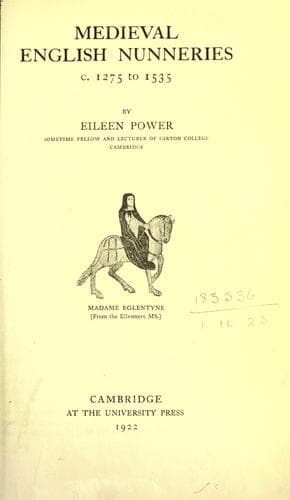
Medieval English Nunneries c. 1275 to 1535Power, Eileen
History
Medieval English Nunneries c. 1275 to 1535
Power, Eileen
Convents -- England; Monastic and religious life of women -- History
Sometimes the abbeys found it cheaper to compound with the King for a
certain sum of money and thus to purchase the right of administering their
own temporalities, saving to the King, as a rule, knights' fees,
advowsons, escheats and sometimes wards and marriages. Romsey Abbey
secured this privilege, after the escheator had already entered, in 1315,
for a fine of forty marks; but in 1333, when there was another voidance,
the convent had to agree to pay L40 for the first two months and _pro
rata_ for such time as the voidance continued, saving to the King knights'
fees, advowsons and escheats[582]. In 1340 the royal escheator was ordered
to let the Prioress and Convent of Wherwell have the custody of their
temporalities, in accordance with a grant made some years previously, by
which the house was to render L230 for a year and _pro rata_[583]. In 1344
a similar order was made in the case of Wilton, whose late Abbess (prudent
woman) had seized the opportunity to purchase the right for L60 from the
King, when he lay at Orwell before crossing the sea[584]. Similarly, the
next year, Shaftesbury received the custody of its temporalities in
consideration of a fine of L100, made with the King by its Abbess, in the
second year of his reign[585]. With four great abbeys falling vacant in
little over ten years, the royal exchequer reaped a good harvest; and
though the payment of a lump sum was better than falling into the hands of
the escheator, and though the nuns would make haste to elect a new abbess
as soon as possible, a voidance was always a costly matter.
Public-domain text, read in full here on John Shaqi.
Reviews
Reviews
No reviews yet
Be the first to share your thoughts on this work.
Elsewhere in the archive
Join the Discussion
Join the discussion
Sign in to leave a comment or review.
Sign InorCreate an account