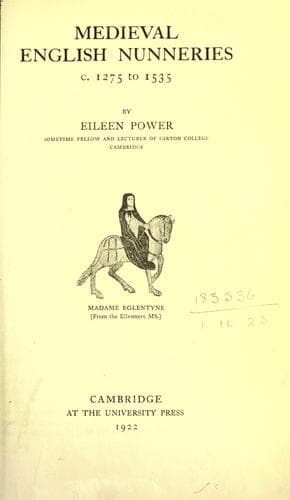
Medieval English Nunneries c. 1275 to 1535Power, Eileen
History
Medieval English Nunneries c. 1275 to 1535
Power, Eileen
Convents -- England; Monastic and religious life of women -- History
The nunneries also suffered considerable pecuniary loss by the right
possessed in certain cases by the patron of a house, to take the profits
of its temporalities during voidance through the death or resignation of
its superior, sometimes enjoying them himself and sometimes granting the
custody of the house to someone else[577]. It is obvious that serious loss
might be entailed upon the community, if the patron refrained for some
time from granting his _conge d'elire_. It was for this reason that the
Convent of Whiston wrote in 1308 to the Bishop-elect of Worcester, their
patron, praying that "considering the smallness of the possessions of the
nuns of Whiston, in his patronage, which compelled the nuns formerly to
beg, and for the honour of religion and the frailness of the female sex"
he would grant them licence to elect a new prioress and would confirm the
same election; and the Prior of Worcester also addressed a letter to the
commissary-general on their behalf[578]. The King exercised with great
regularity his rights of patronage, and the direct pecuniary loss,
sustained by a house in being deprived of the profits of its
temporalities, seems to have been the least of the evils which resulted,
if the state of affairs described in the petition addressed to the crown
by the Abbess and Convent of Shaftesbury in 1382 was at all common. After
a moving description of the straits to which they were reduced[579], they
begged that the King would, on future occasions of voidance, allow the
community to retain the administration of the Abbey and of its
temporalities, rendering the value thereof to the King while the voidance
lasted, so that no escheator, sheriff or other officer should have power
to meddle with them:
understanding, most redoubtable lord, that by means of your grace in
this matter great relief and amendment, please God, shall come to your
same house, and no damage can ensue to you or to your heirs, nor to
any other, save only to your officers, who in such times of voidance
are wont to make great destructions and wastes and to take therefrom
great and divers profits to their own use, whence nothing cometh to
your use, as long as the said voidance endures, if only for a short
time[580].
St Mary's, Winchester, also pleaded the royal administration of its
temporalities as one reason for its impoverishment, when petitioning the
Pope for leave to appropriate the church of Froyle in 1343 and 1346[581].
Public-domain text, read in full here on John Shaqi.
Reviews
Reviews
No reviews yet
Be the first to share your thoughts on this work.
Elsewhere in the archive
Join the Discussion
Join the discussion
Sign in to leave a comment or review.
Sign InorCreate an account