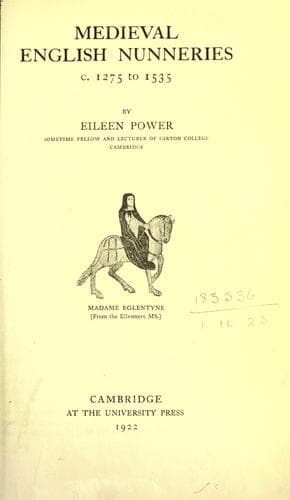
Medieval English Nunneries c. 1275 to 1535Power, Eileen
History
Medieval English Nunneries c. 1275 to 1535
Power, Eileen
Convents -- England; Monastic and religious life of women -- History
The obligation to receive a nun on the nomination of the king or the
bishop was not the only burden upon the finances of the nunneries. Abbeys
in the patronage of the Crown were upon occasion obliged also to find
maintenance for other persons, men as well as women, who never became
members of their community. The right to demand a pension for one of the
royal clerks was sometimes exercised on the occasion of a voidance, and
the money had in most cases to be paid until such time as the young man
was provided with a suitable benefice by the Abbey. The Abbess of Romsey
was ordered to give a pension to William de Dereham in 1315 by reason of
her new election[610]; John de St Paul was sent to the same house in
1333[611], William de Tydeswell in 1349[612]. The right is also found in
exercise at Wherwell[613], St Mary's, Winchester[614], Shaftesbury[615],
Wilton[616], Delapre (Northampton)[617], Barking[618] and Elstow[619]. In
certain cases the Bishop possessed a similar right on the occasion of his
own consecration; for instance John of Pontoise, Bishop of Winchester,
wrote to the Abbess of St Mary's, Winchester, in 1283, complaining
that whereas his predecessors had by a laudable custom presented their
own clerks to the first benefice in the patronage of a religious house
vacant after their establishment in the bishopric, they (the nuns) had
recently presented a nominee of their own to a benefice then vacant.
Two years later the Abbess and Convent of Wherwell wrote to him,
voluntarily offering him the next vacant benefice in their patronage for
one of his clerks; and in 1293 he reminded the nuns of Romsey that they
were bound by agreement to do likewise[620]. Similarly Simon of Ghent,
Bishop of Salisbury, directed the Abbess of Shaftesbury to provide for
Humphrey Wace in 1297[621]. The demand to pension a clerk, like the demand
to receive a nun, was sometimes resisted by the convents. In the early
part of his reign Edward II ordered the Sheriff of Bedford
to distrain the Abbess of Elstow by all her lands and chattels in his
bailiwick and to answer to the King for the issues and to have her
body before the King at the octaves of Hilary next, to answer why,
whereas she and her convent, by reason of the new creation of an
Abbess, were bound to give a pension to a clerk, to be named by the
King and he had transferred the option to his sister Elizabeth
Countess of Hereford and had asked the Abbess to give it to her
nominee they had neglected to do so[622].
The end of the story is contained in a petition printed in the _Rolls of
Parliament_, wherein the Abbess and Convent of "Dunestowe" (Elstow)
informed the King in 1320
Public-domain text, read in full here on John Shaqi.
Reviews
Reviews
No reviews yet
Be the first to share your thoughts on this work.
Elsewhere in the archive
Join the Discussion
Join the discussion
Sign in to leave a comment or review.
Sign InorCreate an account