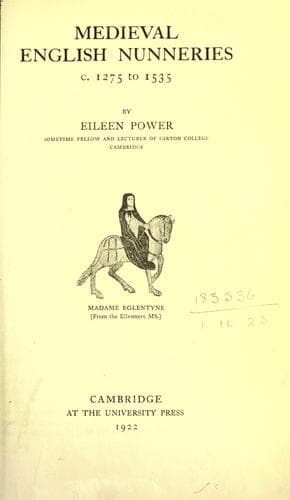
Medieval English Nunneries c. 1275 to 1535Power, Eileen
History
Medieval English Nunneries c. 1275 to 1535
Power, Eileen
Convents -- England; Monastic and religious life of women -- History
The nuns evidently asked the support of the Bishop (which accounts for the
presence of their letter in his Register) for about the same time
Grandisson also wrote an informal letter in French to the King, begging
him to give up his design to place his cousin Johanete de Tourbevyle at
Polsloe, on the ground that the nuns held all that they possessed in frank
almoign and were so poor that it would be unpardonable to entail upon
them a charge, which would become a precedent for ever:
"Wherefore, dear Sire," he continued, "If it please you, hold us
excused of this thing and put this thought from you. And for love of
you, to whom we are much beholden aforetime, and to show you that we
make no feigned pretence, ordain, if it please you, elsewhere for her
estate, and we will very willingly give somewhat reasonable out of our
own goods towards it; for this we may safely do[608]."
It is not impossible that the disinclination of the nunneries to receive
royal and episcopal nominees was in part due to dislike of taking an
entirely unknown person into the close life of the community, in which so
much depended upon the character and disposition of the individual. The
right seems nearly always to have been exercised in favour of well-born
girls, but though the bishops endeavoured to send only suitable novices,
their knowledge of the character of their protegees would sometimes appear
to have rested upon hearsay rather than upon personal acquaintance--"_ut
credimus_," "_come nous sumez enformez_." On at least one occasion the
nuns who resisted a bishop's nominee were to our knowledge justified by
later events. In 1329 Ralph of Shrewsbury, the new Bishop of Bath and
Wells, wrote to the Prioress and Convent of Cannington, desiring them to
receive Alice, daughter of John de Northlode, to whom he had granted the
right, "par resoun de nostre premiere creacion," on the request of Sir
John Mautravers; four years later he was obliged to repeat the order,
because the convent "had not yet been willing to receive the said Alice."
The end of the story is to be found in the visitation report of 1351[609].
It is impossible to say whether the convent corrupted Alice or Alice the
convent; but it is unfortunate that the Bishop's nominee should have been
implicated.
Public-domain text, read in full here on John Shaqi.
Reviews
Reviews
No reviews yet
Be the first to share your thoughts on this work.
Elsewhere in the archive
Join the Discussion
Join the discussion
Sign in to leave a comment or review.
Sign InorCreate an account