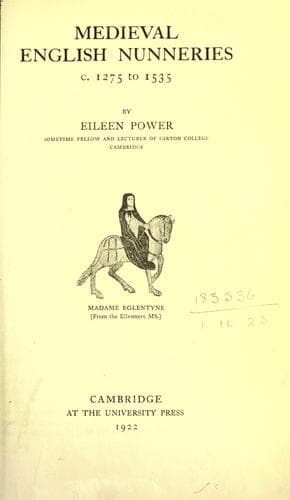
Medieval English Nunneries c. 1275 to 1535Power, Eileen
History
Medieval English Nunneries c. 1275 to 1535
Power, Eileen
Convents -- England; Monastic and religious life of women -- History
The obligation to provide corrodies for royal nominees pressed more
heavily than the duty of pensioning royal clerks. A corrody was originally
a livery of food and drink given to monks and nuns, but the term was
extended to denote a daily livery of food given to some person not of the
community and frequently accompanied by suitable clothing and a room in
which to live. Hence corrodians were often completely kept in board and
lodging, having the right to everything that a nun of the house would have
(a "nun's corrody") and sometimes allowed to keep a private servant, who
had the right to the same provision as the regular domestics of the house
(a "servant's corrody"). The King, indeed, looked upon the monastic houses
of his realm as a sort of vast Chelsea Hospital, in which his broken-down
servants, yeomen and officials and men-at-arms, might end their days. Thus
he obtained their grateful prayers without putting his hand into his
purse. There must have been hundreds of such old pensioners scattered up
and down the country, and judging from the number of cases in which one
man is sent to receive the maintenance lately given to another, deceased,
some houses had at least one of them permanently on the premises. Many a
hoary veteran found his way into the quiet precincts of a nunnery:
His helmet now shall make a hive for bees;
And, lovers' sonnets turn'd to holy psalms,
A man-at-arms must now serve on his knees,
And feed on prayers, which are Age his alms.
In the intervals between feeding on prayers he must have been vastly
disturbing and enthralling to the minds of round-eyed novices, with his
tales of court and camp, of life in London town or long campaigns in
France, or of how John Copeland had the King of Scots prisoner and what
profit he got thereby.
In the last three months of 1316 Edward II sent seventeen old servants to
various religious houses, and among them Henry de Oldyngton of the avenary
was sent to Barking, to receive such maintenance as William de Chygwell,
deceased, had in that house[626]. In 1328 Roger atte Bedde, the King's
yeoman, who served the King and his father, was sent to St Mary's,
Winchester, instead of James le Porter, deceased[627]; and in 1329 the
Abbess and Convent of Shaftesbury were requested to admit to their house
Richard Knight, spigurnel of the King's chancery, who had long served the
King and his father in that office, and to administer to him for his life
such maintenance in all things as Robert le Poleter, deceased, had in
their house[628]. The unlucky convent of Wilton apparently had to support
two pensioners, for in 1328 Roger Liseway was sent there in place of Roger
Danne and the next year John de Odiham, yeoman of the chamber of Queen
Philippa, took the place of John de Asshe[629].
It was doubtless even more common for the widows of the King's dependents
to be sent to nunneries, and he must often have received such a petition
as was addressed by Agnes de Vylers to Edward III:
Public-domain text, read in full here on John Shaqi.
Reviews
Reviews
No reviews yet
Be the first to share your thoughts on this work.
Elsewhere in the archive
Join the Discussion
Join the discussion
Sign in to leave a comment or review.
Sign InorCreate an account