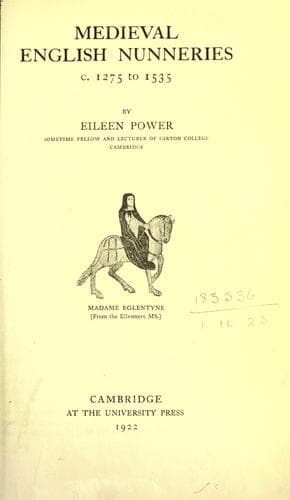
Medieval English Nunneries c. 1275 to 1535Power, Eileen
History
Medieval English Nunneries c. 1275 to 1535
Power, Eileen
Convents -- England; Monastic and religious life of women -- History
A nostre Seigneur le Roi et a son Conseil, prie vostre poure veve
Agneys, qi fut la femme Fraunceys de Vylers, jaditz Bachiler vostre
piere, qe vous pleise de vostre grace avoir regard du graunt service
qe le dit Fraunceys ad fait a vostre dit piere et ed vostre ayel, en
la Terre Seinte, Gascoigne, Gales, Escoce, Flaundres et en Engleterre,
et graunter au dit Agneys une garisoun en l'Abbeye de Berkyng, c'est
assaver une mesoun & la droite de une Noneyme pour la sustinaunce de
lui et de sa file a terme de lour vie, en allegaunce de l'alme vostre
dit piere, qi promist al dit Fraunceys eide pour lui, sa femme et ses
enfaunz.
"Il semble a conseil q'il est almoigne de lui mander ou aillours, s'il
plest a Roi," was the reply; so Agnes and her daughter might end their
days in peace, and Barking be the poorer for their appetites[630]. At
Barking the King had the right to claim a corrody at each new election of
an abbess, as Agnes de Vylers doubtless knew; as early as 1253 its Abbess
was exempted from being charged with _conversi_ and others, because she
had granted food and vesture for life to Philippa de Rading and her
daughter[631]. Other nunneries in the royal patronage were under a similar
obligation. In 1310 Juliana la Despenser was sent to Romsey, to be
provided with fitting maintenance for herself and for her maid during her
lifetime[632] and in 1319 Mary Ridel was sent to Stainfield to be
maintained for life[633]. There were the usual attempts to escape from a
costly and burdensome obligation; Romsey seems to have been successful in
repelling Juliana la Despenser, for in the following month the King sent
her to Shaftesbury, requesting the nuns to "find her for life the
necessities of life according to the requirements of her estate, for
herself and for the damsel serving her, and to assign her a chamber to
dwell in, making letters patent of the grant"[634]. Stainfield was less
successful in the matter of Mary Ridel; the usual plea of poverty was
considered insufficient and the convent was ordered to receive her, to
supply her with food, clothing and other necessities and to make letters
patent, specifying what was due to her[635].
Public-domain text, read in full here on John Shaqi.
Reviews
Reviews
No reviews yet
Be the first to share your thoughts on this work.
Elsewhere in the archive
Join the Discussion
Join the discussion
Sign in to leave a comment or review.
Sign InorCreate an account