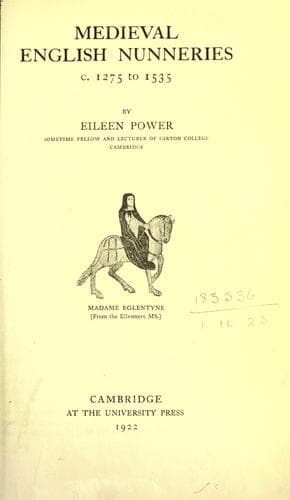
Medieval English Nunneries c. 1275 to 1535Power, Eileen
History
Medieval English Nunneries c. 1275 to 1535
Power, Eileen
Convents -- England; Monastic and religious life of women -- History
At Arthington in 1318 the Prioress was specially ordered to consult the
convent in sales of wool and other business matters[714]; the Prioress of
Sinningthwaite the next year was told to take counsel with the older nuns
and in all writings under the common seal to employ a faithful clerk and
to have the deed read, discussed and sealed in the presence of the whole
convent, those who spoke against it on reasonable grounds being heard and
the deed if necessary corrected[715]. Provision for the safe custody of
the common seal, and for the assent of the whole convent to all writings
which received its imprint, was a necessary corollary to the demand that
the Prioress should consult her nuns in matters of business. Medieval
superiors were constantly charged with keeping the common seal in their
own custody[716] and nuns and bishops alike objected to a custom which
rendered the convent responsible for any rash agreement into which the
Prioress might enter. Elaborate arrangements for the custody of the seal
are therefore common in visitatorial injunctions. In 1302 Bishop John of
Pontoise wrote to Romsey that
whereas from the bad keeping of the common seal many evils to the
house have hitherto happened (as the Bishop has now learned from the
experience of fact), and also may happen unless wholesome remedy be
applied, three at least of the discreeter ladies shall be appointed by
the Abbess and by the larger and wiser part of the convent to keep the
seal; and when any letter shall be sealed with the common seal in the
chapter before the whole convent, it shall be read and explained in an
intelligible tongue to all the ladies, publicly, distinctly and openly
and afterwards sealed in the same chapter, (not in corners or
secretly, as has hitherto been the custom,) and signed as it is read,
so that what concerns all may be approved by all. Which done the seal
shall be replaced in the same place under the said custody[717].
These injunctions were repeated by Bishop Woodlock nine years later, but
in 1387 William of Wykeham laid down much more stringent rules. The seal
was to be kept securely under seven, or at least five locks and keys, of
which one key was to be in the custody of the abbess and the others to
remain with some of the more prudent and mature nuns, nominated by the
convent; no letter was to be sealed without first being read before the
whole convent in the vulgar tongue and approved by all or by the greater
and wiser part of the nuns[718]. Seven locks was an unusually large
number; usually three, or even two, were ordered. At Malling, where, as we
have seen, Bishop Hamo of Hythe unwillingly confirmed an "insufficient and
ignorant" woman as Abbess, he took the extreme step of sequestrating the
common seal and forbidding it to be used without his permission[719].
Public-domain text, read in full here on John Shaqi.
Reviews
Reviews
No reviews yet
Be the first to share your thoughts on this work.
Elsewhere in the archive
Join the Discussion
Join the discussion
Sign in to leave a comment or review.
Sign InorCreate an account