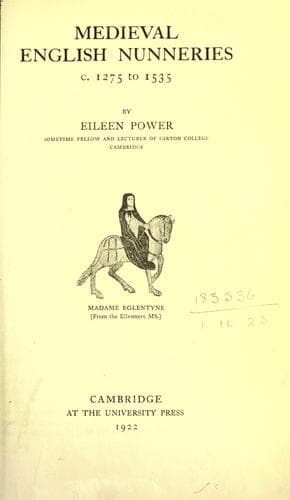
Medieval English Nunneries c. 1275 to 1535Power, Eileen
History
Medieval English Nunneries c. 1275 to 1535
Power, Eileen
Convents -- England; Monastic and religious life of women -- History
and a further letter from the Archbishop to the Subprioress and nuns
ordered them to display the _status domus_ to the commissioners, as it was
when the Prioress took office and as it was at the time he wrote. She
resigned shortly afterwards, _sentiens se impotentem_; but in 1315 her
successor was enjoined to draw up a certified statement showing the credit
and debit accounts of the house and to send it to the Archbishop before a
certain date[735]. Usually the Bishop demanded not only the account roll
of a house, but also an inventory, doubtless in order that he might see
whether anything had been alienated, and these inventories sometimes
remain attached to the account of the visitation preserved in the
episcopal register[736].
If a Prioress were found to be hopelessly incompetent or unscrupulous, but
not bad enough to be deprived of her position, Bishops sometimes took the
extreme measure of appointing one or more coadjutresses, to govern the
house in conjunction with her; and often (even when there was no complaint
against the Prioress) the nuns were ordered to elect treasuresses, to
receive and disburse the income of the house from all sources. One of the
_comperta_ at the visitation of Swine in 1268 was to the effect that
the sums of money which are bestowed in charity upon the convent, for
pittances and garments and other necessary uses, are received by the
Prioress; which ought the rather to be in the custody of two honest
nuns and distributed to those in need of them, and in no wise
converted to other uses[737].
At Nunkeeling in 1314 it was ordained that all money due to the house
should be received by two bursars, elected by the convent[738], and in
1323 Bishop Cobham of Worcester made a similar injunction at Wroxall, that
two sisters were to be chosen by the chapter, to do the business of the
convent in receiving rents, etc.[739] Elaborate arrangements for the
appointment of treasuresses were made by Bishop Bokyngham at Elstow and at
Heynings, in 1388 and 1392 respectively, and by Bishop Flemyng at Elstow
in 1421-2[740]. It will suffice here to quote the much earlier arrangement
made by Archbishop Peckham at Usk in 1284:
Public-domain text, read in full here on John Shaqi.
Reviews
Reviews
No reviews yet
Be the first to share your thoughts on this work.
Elsewhere in the archive
Join the Discussion
Join the discussion
Sign in to leave a comment or review.
Sign InorCreate an account