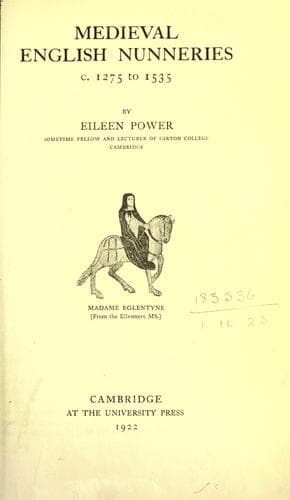
Medieval English Nunneries c. 1275 to 1535Power, Eileen
History
Medieval English Nunneries c. 1275 to 1535
Power, Eileen
Convents -- England; Monastic and religious life of women -- History
"Since," he wrote, "lately visiting you by our metropolitan right, we
found you in a most desolate state (_multipliciter desolatas_),
desiring to avoid such desolation in future, we order, by the counsel
of discreet men, that henceforth two provident and discreet nuns be
elected by the consent of the prioress and community; into whose hands
all the money of the house shall be brought, whether from granges, or
from appropriated churches, or coming from any other offerings, to be
carefully looked after by their consent. And as well the Prioress as
the other nuns shall receive (money for) all necessary expenses from
their hands and in no manner otherwise. And we will that these nuns be
called Treasuresses, which Treasuresses thrice in the year, to wit in
Lent, Whitsuntide and on the Feast of St Michael, shall render account
before the Prioress for the time being and before five or six elders
of the chapter."
In addition they were to have a priest as _custos_ or administrator of
their temporal and spiritual possessions[741].
The appointment of a coadjutress to the head of a house in the
administration of its affairs is of the same nature. The appointment of
coadjutresses was a favourite device with Archbishop Peckham, to check an
extravagant or incapable head. At the great abbey of Romsey three
coadjutresses were appointed, without whose testimony and advice the
Abbess was to undertake no important business[742]. At Wherwell one
coadjutress only, a certain J. de Ver, was appointed in 1284, and the same
year the Archbishop wrote to his commissary on the subject of the Priory
of the Holy Sepulchre, Canterbury:
Since by the carelessness and neglect of the Prioress the goods of the
house are said to be much wasted, we wish you to assign to her two
coadjutresses, to wit Dame Sara and another of the more honest and
wise ladies; but let neither be Benedicta, who is said to have greatly
offended the whole community by her discords.
Public-domain text, read in full here on John Shaqi.
Reviews
Reviews
No reviews yet
Be the first to share your thoughts on this work.
Elsewhere in the archive
Join the Discussion
Join the discussion
Sign in to leave a comment or review.
Sign InorCreate an account