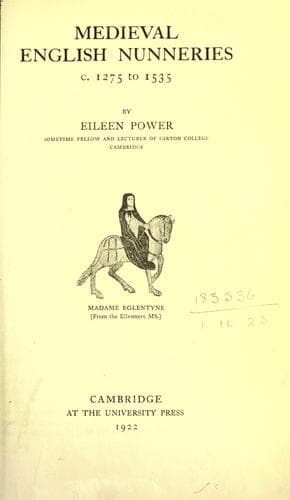
Medieval English Nunneries c. 1275 to 1535Power, Eileen
History
Medieval English Nunneries c. 1275 to 1535
Power, Eileen
Convents -- England; Monastic and religious life of women -- History
Whitstable was made _custos_, "by reason of the miserable want and extreme
poverty of the said house" (1359) and for the same reason another secular
cleric received the "supervision, custody or administration" of the same
house in 1365[784]. In 1366 Thomas Hatfield, Bishop of Durham,
pitying the miserable state of St Bartholomew's at Newcastle-on-Tyne,
both as to spirituals and temporals, and dreading the immediate ruin
thereof, unless some speedy remedy should be applied, committed it to
the care of Hugh de Arnecliffe, priest in the church of St Nicholas in
Newcastle-upon-Tyne, strictly enjoining the prioress and nuns to be
obedient to him in every particular and trusting to his prudence to
find relief for the poor servants of Christ here, in their poverty and
distress.[785]
Sometimes the nuns themselves begged for a _custos_ to assist them, in
terms which show that they found the management of their own finances too
much for them. At Godstow in 1316 the King was obliged, at the request of
the Abbess and nuns, to take the Abbey into his special protection "on
account of its miserable state," and he appointed the Abbot of Eynsham and
the Prior of Bicester as keepers, ordering them to pay the nuns a certain
allowance and to apply the residue to the discharging of their debts[786].
Similarly in 1327 the Prioress and nuns of King's Mead, Derby, represented
themselves as much reduced, and begged the King to take the house into his
special protection, granting the custody of it to Robert of Alsop and
Simon of Little Chester, until it should be relieved. Three months later
Edward III granted it protection for three years and appointed Robert of
Alsop and Simon of Little Chester custodians, who, after due provision for
the sustenance of the prioress and nuns, were to apply the issues and
rents to the discharge of the liabilities of the house and to the
improvement of its condition[787]. Some interesting evidence in this
connection was given during Alnwick's visitations of the diocese of
Lincoln. When Clemence Medforde, the Prioress of Ankerwyke, was asked
whether she had observed the Bishop's injunctions, she answered
Public-domain text, read in full here on John Shaqi.
Reviews
Reviews
No reviews yet
Be the first to share your thoughts on this work.
Elsewhere in the archive
Join the Discussion
Join the discussion
Sign in to leave a comment or review.
Sign InorCreate an account