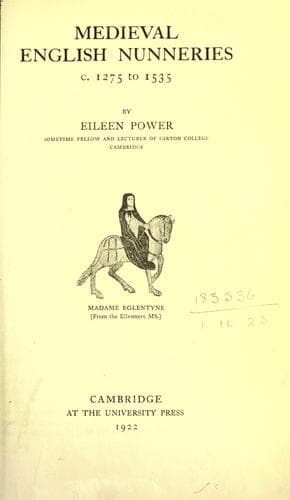
Medieval English Nunneries c. 1275 to 1535Power, Eileen
History
Medieval English Nunneries c. 1275 to 1535
Power, Eileen
Convents -- England; Monastic and religious life of women -- History
that such injunctions were, and are, well observed as regards both her
and her sisters in effect and according to their power, except the
injunction whereby she is bound to supply to her sisters sufficient
raiment for their habits, and as touching the non-observance of that
injunction she answers that she cannot observe it, because of the
poverty and insufficiency of the resources of the house, which have
been much lessened by reason of the want of a surveyor or steward
(_yconomus_). Wherefore she besought my lord's good-will and
assistance that he would deign with charitable consideration to make
provision of such steward or director.... And when these nuns, all and
several, had been so examined and were gathered together again in the
chapter house, the said Depyng (the Visitor) gave consideration to two
grievances, wherein the priory and nuns alike suffer no small damage,
the which, as he affirmed, were worthy of reform above the rest of
those that stood most in need of reform, to wit the lack of raiment
for the habit, of bedclothes and of a steward or seneschal, but in
these matters, as he averred, he could not apply a remedy for the
nonce without riper deliberation and consultation with my lord[788].
Similarly the old Prioress of St Michael's Stamford, when asking for the
appointment of two nuns as treasuresses, complained "that she herself is
impotent to rule temporalities, nor have they an industrious man to
supervise these and to raise and receive (external payments)"; another nun
said that "they have not a discreet layman to rule their temporalities,"
and a third also complained of the lack of a "receiver"[789]. At Gokewell,
on the other hand, the Prioress said "that the rector of Flixborough is
their steward (_yconomus_) and he looks after the temporalities and not
she"; he was evidently a true friend to the nuns, for she said "that the
house does not exceed L10 in rents and is greatly in debt to the rector of
Flixborough"[790]. The terms of appointment of _custodes_ often specify
the inexpertness of the nuns, or their need for someone to supervise the
management of their estates[791]. Perhaps the fullest set of instructions
to a _custos_ which have survived are those given by Archbishop Melton to
Roger de Saxton, rector of Aberford, in making him _custos_ of Kirklees in
1317:
Public-domain text, read in full here on John Shaqi.
Reviews
Reviews
No reviews yet
Be the first to share your thoughts on this work.
Elsewhere in the archive
Join the Discussion
Join the discussion
Sign in to leave a comment or review.
Sign InorCreate an account