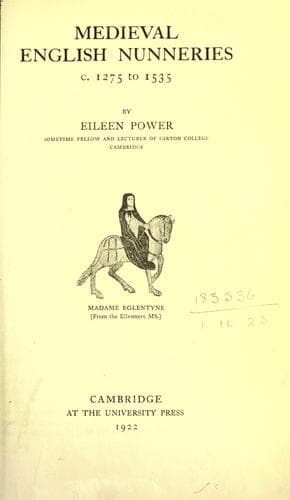
Medieval English Nunneries c. 1275 to 1535Power, Eileen
History
Medieval English Nunneries c. 1275 to 1535
Power, Eileen
Convents -- England; Monastic and religious life of women -- History
The linguistic learning of English nuns at different periods was similar
to that of the gentry outside the convent. It was not possible after the
beginning of the fourteenth century (perhaps even during the last half of
the thirteenth century) to assume in them that acquaintance with Latin,
the learned and ecclesiastical tongue, which was generally assumed in
their brothers the monks. Their learning was similar to that of
contemporary laymen of their class, rather than of contemporary monks; and
it went through exactly the same phases as did the coronation oath. About
1311 the King's oath occurs in Latin among the State documents, with the
note appended that "if the King were illiterate" he was to swear in
French, as Edward II did in 1307; but in 1399 when Henry IV claimed the
throne, he claimed it in English, "In the name of the Fadir, Son and Holy
Gost, I Henry of Lancastre, chalenge şis Rewme of Yngland"[826]. Similarly
towards the close of the thirteenth century the English bishops begin to
write to their nuns in French, because they are no longer "literate," in
the sense of understanding Latin. Throughout this century the nuns are
able to speak the courtly tongue; they use it for their petitions; and
Chaucer's Prioress boasts it among her accomplishments at the close of the
century,
And Frensh she spak ful faire and fetisly
After the scole of Stratford atte Bowe,
For French of Paris was to her unknowe.
But French, like Latin, is beginning to die away. It hardly ever occurs in
petitions after the end of the century; and in the fifteenth and sixteenth
centuries the Bishops almost invariably send their injunctions to the nuns
in English. The majority of nuns during these two centuries would seem to
have understood neither French nor Latin[827].
The evidence of the bishops' registers is worth considering in more
detail. The bishops were genuinely anxious that the reforms set forth in
their injunctions should be carried out by the nuns, and they were
therefore at considerable pains to send the injunctions in language which
the nuns could understand. There are few surviving injunctions belonging
to the thirteenth century; and their evidence is missed. Archbishop Walter
Giffard in 1268[828] and Archbishop Newark in 1298[829] write to the nuns
of Swine in Latin, a language which they seem to have employed habitually
when writing to nunneries. Archbishop Peckham sometimes writes to the
Godstow nuns in Latin (1279) and sometimes in French (1284)[830]; it is to
be noted that his French letter is of a more familiar type. Bishop
Cantilupe of Hereford writes about 1277 to the nuns of Lymbrook in Latin,
but his closing words raise considerable doubt as to whether an
understanding of Latin can be generally assumed in nunneries at this
period, for he says "you are to cause this our letter to be expounded to
you several times in the year by your penancers, in the French or English
tongue, whichever you know best"[831].
Public-domain text, read in full here on John Shaqi.
Reviews
Reviews
No reviews yet
Be the first to share your thoughts on this work.
Elsewhere in the archive
Join the Discussion
Join the discussion
Sign in to leave a comment or review.
Sign InorCreate an account