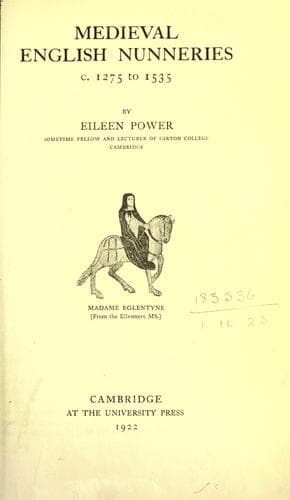
Medieval English Nunneries c. 1275 to 1535Power, Eileen
History
Medieval English Nunneries c. 1275 to 1535
Power, Eileen
Convents -- England; Monastic and religious life of women -- History
Again it would seem clear that the nun who was fully qualified to "bear
the burden of the choir" ought to be able to understand what she read, as
well as to read it, and this raises at once the study of Latin in
nunneries. Here again the nuns do not emerge very well from inquiry. Some
there were no doubt who knew a little Latin, even in the fourteenth,
fifteenth and sixteenth centuries; but the more the inquirer studies
contemporary records, the more he is driven to conclude that the majority
of nuns during this period knew no Latin; they must have sung the offices
by rote and though they may have understood, it is to be feared that the
majority of them could not construe even a _Pater Noster_, an _Ave_ or a
_Credo_. Let us take the evidence for the different centuries in turn. The
language of visitation injunctions affords some clue to the knowledge of
the nuns. It must be remembered that throughout the whole period Latin was
always the learned and ecclesiastical language; and the communications
addressed by a bishop to the monastic houses of his district, notices of
visitation, mandates and injunctions would normally be in Latin; and when
he was addressing monks they were in fact almost always in this tongue.
After Latin the language next in estimation was French. This had been the
universal language of the upper class and up till the middle of the
fourteenth century it was still _par excellence_ the courtly tongue. But
it was rapidly ceasing to be a language in general use and the
turning-point is marked by a statute of 1362, which ordains that
henceforth all pleas in the law courts shall be conducted in English,
since the French language "is too unknown in the said realm." At the close
of the century even the upper classes were ceasing to speak French and the
English ambassadors to France in 1404 had to beseech the Grand Council of
France to answer them in Latin, French being "like Hebrew" to them[825].
In the fifteenth century French was a mere educational adornment, which
could be acquired by those who could get teachers.
Public-domain text, read in full here on John Shaqi.
Reviews
Reviews
No reviews yet
Be the first to share your thoughts on this work.
Elsewhere in the archive
Join the Discussion
Join the discussion
Sign in to leave a comment or review.
Sign InorCreate an account