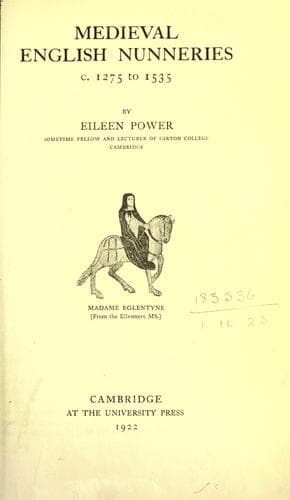
Medieval English Nunneries c. 1275 to 1535Power, Eileen
History
Medieval English Nunneries c. 1275 to 1535
Power, Eileen
Convents -- England; Monastic and religious life of women -- History
When we pass from the fourteenth to the fifteenth century it is clear that
even French was becoming an unknown tongue to the nuns; nearly all
injunctions are from this time forward written in English. At Redlingfield
in 1427, the seven nuns and two novices were assembled in the chapter
house, where the deputy visitor read his commission, first in Latin and
then in the vulgar tongue, in order that the nuns might better understand
it[839]. It is true that Bishops Flemyng and Gray send Latin injunctions
to Elstow and Delapre Abbeys in 1422 and 1433 respectively; but Flemyng
orders "that the premises, all and sundry, be published and read openly
and in the vulgar mother tongue eight times a year"[840], and Gray writes
that his injunctions are to be translated into the mother tongue and
fastened in some conspicuous place[841]. The best evidence of all for the
state of learning in nunneries during the first half of the fifteenth
century is to be found in the invaluable records of Alnwick's visitations
of the Lincoln diocese. Now it should be noted that when Alnwick visited
houses of monks or canons, the sermon, which was generally preached on
such occasions by one of the learned clerics who accompanied him, was
invariably preached in Latin. Moreover, all injunctions sent to male
houses after visitation were sent in Latin also. The assumption still was
that these monasteries were homes of learning and acquainted with the
language of learning. With the nunneries it was otherwise. The sermons
were always preached "in the vulgar tongue" and the injunctions were
always sent in English. It was not even pretended that the nuns would
understand Latin. Moreover it is quite plain that when the preliminary
notices of visitation had been sent in Latin, they had been very
imperfectly understood; and that when it was necessary for a Prioress
herself to draw up a certificate in writing, she was often quite unable to
do so.
A few extracts from Alnwick's records will illustrate the complete
ignorance of Latin and general illiteracy in these houses. At Ankerwyke
(1441) it is noted:
And then when request had been made of the prioress by the reverend
father for the certificate of his mandate conveyed to the said
prioress for such visitation, the same prioress, instead of the
certificate delivered the original mandate itself to the said reverend
father, affirming that she did not understand the mandate itself, nor
had she any man of skill or other lettered person to instruct what she
should do in this behalf[842].
At Markyate (1442), when the same certificate was asked for, the Prioress
said that she had not a clerk who was equipped for writing such a
certificate, on the which head she submitted herself to my lord's
favour and then showed my lord in lieu of a certificate the original
mandate itself and the names of the nuns who had been summoned[843].
Public-domain text, read in full here on John Shaqi.
Reviews
Reviews
No reviews yet
Be the first to share your thoughts on this work.
Elsewhere in the archive
Join the Discussion
Join the discussion
Sign in to leave a comment or review.
Sign InorCreate an account