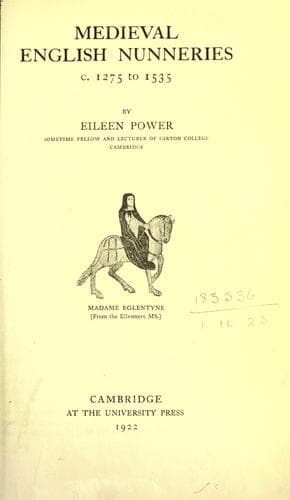
Medieval English Nunneries c. 1275 to 1535Power, Eileen
History
Medieval English Nunneries c. 1275 to 1535
Power, Eileen
Convents -- England; Monastic and religious life of women -- History
Similarly the Prioress of Fosse showed the original mandate in place of
the certificate, and the Prioresses of St Michael's Stamford and Rothwell
had failed to draw up the certificate[844]. The Prioress of Gokewell
(1440) was said to be "exceedingly simple," all the temporalities of the
house being ruled by a steward; she also declared that "she knows not how
to compose a formal certificate, in that she has no lettered persons of
her counsel who are skilled in this case," and she had been unable to find
the document reciting the confirmation of her election[845]. The poor
convent of Langley seems to have been reduced to complete confusion by the
episcopal mandate. The Prioress
says that she received my lord's mandate on the feast of St Denis
last. Interrogated whether she has a certificate touching execution
thereof, she says no, because she did not understand it, nor did her
chaplain also, to whom she showed it; concerning the which she
surrendered herself to my lord's favour. Wherefore, when the original
mandate had been delivered to my lord and read through in the vulgar
tongue, my lord asked her if she had executed it. She says yes, as
regards the summons of herself and her sisters.... Interrogated if she
has the foundation charter of the house and who is the founder, she
says that Sir William Pantolfe founded the house, but because they are
unversed in letters they cannot understand the writings[846].
It is unnecessary to multiply the evidence of visitation records for the
rest of the fifteenth and for the early sixteenth century: the general
effect is to show us nuns who know only the English language[847]. Let us
turn to the interesting corroborative evidence provided by those who were
at pains to make translations for their use. It must be admitted that this
evidence only confirms the suggestion made above that the nuns often did
not understand the very services which they sang, let alone the Latin
version of their rule, or the Latin charters by which they held their
lands. That they often sang the services uncomprehendingly like parrots is
actually stated by Sir David Lyndesay, the Scottish poet, in his _Dialog
concerning the Monarche_ (1553). He apologises for writing in his native
tongue, unlike those clerks, who wish to prohibit the people from reading
even the scriptures for themselves, and adds
Tharefore I thynk one gret dirisioun
To heir thir Nunnis & Systeris nycht and day
Syngand and sayand psalmes and orisoun,
Nocht vnderstandyng quhat thay syng nor say,
Bot lyke one stirlyng or ane Papingay
Quhilk leirnit ar to speik be lang usage
Thame I compair to byrdis in ane cage[848].
Several translations of the rule of St Benet were made for the special use
of nuns, who knew no Latin. A northern metrical version of the early
fifteenth century explains
Public-domain text, read in full here on John Shaqi.
Reviews
Reviews
No reviews yet
Be the first to share your thoughts on this work.
Elsewhere in the archive
Join the Discussion
Join the discussion
Sign in to leave a comment or review.
Sign InorCreate an account