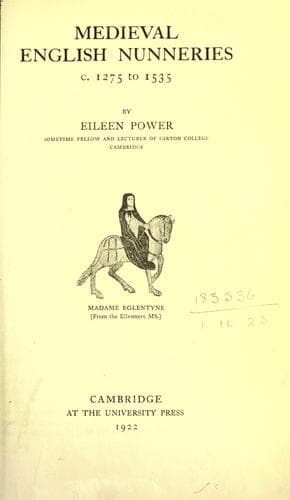
Medieval English Nunneries c. 1275 to 1535Power, Eileen
History
Medieval English Nunneries c. 1275 to 1535
Power, Eileen
Convents -- England; Monastic and religious life of women -- History
Other occupations besides reading filled the working hours of the nuns and
of these spinning and needlework were the most important. Most women in
the middle ages possessed the art of spinning and Aubrey's Old Jacques may
have remembered aright how "he saw from his house the nuns of the priory
(Kington St Michael) come forth into the nymph-hay with their rocks and
wheels to spin," though his memory misled him sorely as to the number of
these ladies. Sometimes a visitation report gives us a glimpse of the nuns
at work: at Easebourne in 1441 the nuns say that the Prioress "compels her
sisters to work continually like hired workwomen and they receive nothing
whatever for their own use from their work, but the prioress takes the
whole profit"[856] and at Catesby in the following year a young nun
complains that the Prioress "setts her to make beds, to sewing and
spinning and other tasks"[857]. Nevertheless it does not seem that the
nuns were in the habit of spinning the wool and flax for their own and
their servants' clothes and account rolls often contain payments made to
hired spinsters, as well as to fullers and weavers.
It is more probable that they busied themselves with needlework and
embroidery, which were the usual occupations of ladies of gentle
birth[858]. Very few traces have unfortunately survived of the work of
English nuns. In earlier centuries English needlework had been famous and
the nuns had been pre-eminent in the making of richly embroidered
vestments. In the thirteenth century, too, English embroidery far
surpassed that made in other countries and it has been conjectured that
"the most famous embroidered vestments now preserved in various places in
Italy are the handiwork of English embroiderers between 1250 and 1300
though their authorship is not as a rule recognised by their present
possessors"[859]. Some of these may have been made by nuns; it is thought
that the famous Syon cope, for long in the possession of the nuns of Syon,
may have been made in a thirteenth century convent in the neighbourhood of
Coventry; but such examples of medieval embroidery as have survived
usually bear no trace of their origin; since a vestment cannot be signed
like a book and it must be remembered that there was a large class of
professional "embroideresses" in the country.
Some, however, of the splendid vestments and altar cloths possessed by the
richer nunneries were probably the work of the nuns. At Langley in 1485
there were, among other rich pieces of embroidery
Public-domain text, read in full here on John Shaqi.
Reviews
Reviews
No reviews yet
Be the first to share your thoughts on this work.
Elsewhere in the archive
Join the Discussion
Join the discussion
Sign in to leave a comment or review.
Sign InorCreate an account