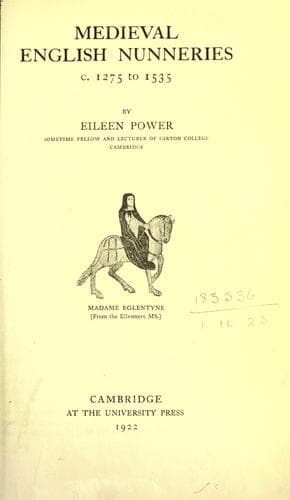
Medieval English Nunneries c. 1275 to 1535Power, Eileen
History
Medieval English Nunneries c. 1275 to 1535
Power, Eileen
Convents -- England; Monastic and religious life of women -- History
Forasmoche as many of you, though ye can synge and rede, yet ye can
not se what the meanynge therof ys; therefore to the onely worshyp
and praysyng of oure lorde Jesu chryste and of hys moste mercyfull
mother oure lady and to the gostly comforte and profyte of youre
soules, I haue drawen youre legende and all youre seruyce in to
Englyshe, that ye shulde se by the vnderstondyng therof, how worthy
and holy praysynge of oure gloryous Lady is contente therin & the more
deuoutely and knowyngly synge yt & rede yt and say yt to her worshyp.
He adds that he has explained the various parts of the divine service for
"symple soulles to vnderstonde," but that he has translated few psalms,
"for ye may haue them of Rycharde hampoules drawynge, and out of Englysshe
bibles, if ye haue lysence therto"[852].
From a passage in the _Myroure_ it appears that the sisters were
accustomed to spend some of their time in reading and advice is given to
them as to the sort of books to read and the way in which to profit by
them; from this it is quite clear that secular learning had no place among
them, their reading being confined to works of ghostly edification[853].
It was their ignorance of Latin which caused the insertion of English
rubrics in the Latin _Processionale_ of the house and which inspired
Richard Whytford, one of the brothers, to translate the splendid
_Martilogium_, which is now in the British Museum, "for the edificacyon of
certayn religyous persones unlerned that dayly dyd rede the same martiloge
in Latyn, not understandynge what they redde"; his translation was printed
by Wynkyn de Worde in 1526[854]. Gascoigne's mention of English bibles is
interesting. Miss Deanesly, in her study of _The Lollard Bible_, has shown
that "it is likely that English nuns were the most numerous orthodox users
of English bibles between 1408 and 1526," but that the evidence for this
use is slight and drawn almost entirely from Syon and Barking, two large
and important houses[855]. Her conclusion is that
it was not the case that the best instructed nuns used Latin Bibles
and the most ignorant English ones: but that the best instructed nuns
were allowed to use English translations, perhaps by themselves,
perhaps to help in the understanding of the Vulgate, while the smaller
nunneries and least instructed nuns almost certainly did not have them
at all.
This goes to confirm the conclusion that even in the greatest houses,
where the nuns were drawn from the highest social classes and might be
supposed to be best educated, the knowledge of Latin was dying out.
Public-domain text, read in full here on John Shaqi.
Reviews
Reviews
No reviews yet
Be the first to share your thoughts on this work.
Elsewhere in the archive
Join the Discussion
Join the discussion
Sign in to leave a comment or review.
Sign InorCreate an account