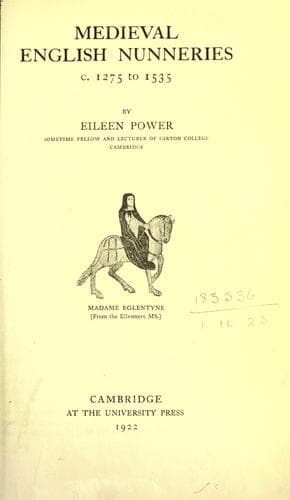
Medieval English Nunneries c. 1275 to 1535Power, Eileen
History
Medieval English Nunneries c. 1275 to 1535
Power, Eileen
Convents -- England; Monastic and religious life of women -- History
The fact is, however, clearly established that all nunneries did not take
children; possibly about two-thirds of them did. The further fact has then
to be recognised that even those nunneries had not necessarily what we
should regard as a school for girls. Not only does it sometimes seem as
though children were taken occasionally and intermittently, rather than
regularly, but the numbers taken were rarely great. Sometimes we do hear
of a house with a large number of pupils. At St Mary's Winchester in 1536
there were as many as twenty-six children, to twenty-six nuns; and at
Polesworth in 1537 Henry VIII's commissioners state vaguely that "repayre
and resort ys made to the gentlemens childern and studiounts that ther doo
lif, to the nombre sometyme of xxx{ti} and sometyme xj{ti} and moo." There
were fifteen nuns in the house at the time and it is likely that the
number of children given is a pardonable exaggeration by local gentlemen
who were interested in preserving the nunnery; but it seems undoubted that
there was a comparatively large school there. At Stixwould, again, in 1440
there were about eighteen children to an equal number of nuns. These,
however, are the largest schools of which we have record. At St Michael's
Stamford in 1440 there were seven or eight children to twelve nuns, at
Catesby in 1442 six or seven children to seven nuns. At Swaffham Bulbeck,
where there were probably eight or nine nuns, there were nine children in
1483. These also are schools, though small schools. But at other houses
there were only one or two children at a time. The accounts of the
Prioress of St Helen's Bishopsgate in 1298 mention only two children,
there were only two at Littlemore in 1445 and two at Sopwell at the time
of the Dissolution. It must be remembered that many nunneries were
themselves very small and their inmates could not have looked after a
large number of children. The examples quoted above suggest that the
number of children hardly ever exceeded the number of nuns. To what
conclusion are we driven when we find that a possible two-thirds of the
convents of England received children and that the largest school of which
we have record numbered only twenty-six children (or thirty if we take the
higher and less probable figure for Polesworth), while most had far fewer?
Surely to represent a majority of girls, or even a majority of girls of
gentle birth, as having received their nurture in convents, would be on
the evidence absurd.
Public-domain text, read in full here on John Shaqi.
Reviews
Reviews
No reviews yet
Be the first to share your thoughts on this work.
Elsewhere in the archive
Join the Discussion
Join the discussion
Sign in to leave a comment or review.
Sign InorCreate an account