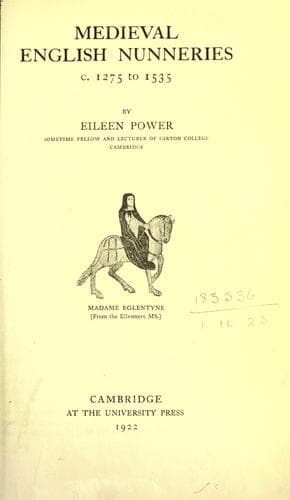
Medieval English Nunneries c. 1275 to 1535Power, Eileen
History
Medieval English Nunneries c. 1275 to 1535
Power, Eileen
Convents -- England; Monastic and religious life of women -- History
Allow no boys or girls to have access to you. There are certain
anchoresses, who are busied in teaching pupils and turn their chambers
into a school. The mistress sits at the window, the child in the
cloister. She looks at each of them; and, during their puerile
actions, now is angry, now laughs, now threatens, now soothes, now
spares, now kisses, now calls the weeping child to be beaten, then
strokes her face, bids her hold up her head, and eagerly embracing
her, calls her her child, her love[887].
Similarly the author of the _Ancren Riwle_ warns his three anchoresses:
An anchoress must not become a schoolmistress, nor turn her
anchoress-house into a school for children. Her maiden may, however,
teach any little girl, concerning whom it might be doubtful whether
she should learn among boys, but an anchoress ought to give her
thoughts to God only[888].
The gist of the matter was that the children constituted a hindrance to
claustral discipline and devotion. It is plain, however, that in this, as
in so many other matters, the reformers were only "beating the air" in
vain with their restrictions. Sympathy must be with the needy nuns, for
even if discipline were weakened thereby, the reception of children was in
itself a very harmless, not to say laudable expedient; and so the
neighbouring gentry as well as the nuns considered it.
An analysis of the attitude of medieval visitors to schoolchildren shows
us the usual attempt to limit what it was beyond their power to prohibit.
Eudes Rigaud, the great Archbishop of Rouen, habitually removed all the
girls and boys whom he found in the houses of his diocese, when he visited
them during the years 1249 to 1269. But in England, at least, the nuns
very soon became too strong for the bishops, who gradually adopted the
policy of fixing an age limit beyond which no children might remain in a
nunnery and sometimes of requiring their own licence to be given before
the boys and girls were admitted. Since the danger of secularisation could
not be removed, it was at least reduced to a minimum, by ensuring that
only very young boys and only girls, who had not yet attained a
marriageable age, should be received. The age limit varied a little with
different visitors and different houses. In the Yorkshire diocese early in
the fourteenth century the age limit was twelve for girls; boys are rarely
mentioned, but at Hampole in 1314 the nuns were forbidden to permit male
children over five to be in the house, as the bishop finds has been the
practice. Bishop Gynewell in 1359 allowed girls up to ten and boys up to
six at Elstow, but forbade boys altogether at Heynings. Bishop Gray
allowed girls under fourteen and boys under eight at Burnham in 1434 and
Bishop Stretton in 1367 allowed boys up to seven at Fairwell. The age
limit tended, it will be seen, to become higher in the course of time;
Alnwick writing to Gracedieu in 1440, forbade all boarders "save
Public-domain text, read in full here on John Shaqi.
Reviews
Reviews
No reviews yet
Be the first to share your thoughts on this work.
Elsewhere in the archive
Join the Discussion
Join the discussion
Sign in to leave a comment or review.
Sign InorCreate an account