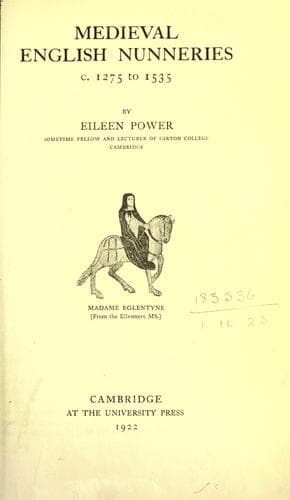
Medieval English Nunneries c. 1275 to 1535Power, Eileen
History
Medieval English Nunneries c. 1275 to 1535
Power, Eileen
Convents -- England; Monastic and religious life of women -- History
uncertain which to pity most, Thomasyn Dynham, a new Prioress left with
this incubus on her hands, or Elizabeth and Jane Knyghte, trying hard to
restrain their appetites and not to grow out of their clothes under her
justly incensed regard. Jane was by now grown up and marriageable
according to the standards of the time and it is tantalising not to know
the end of the dilemma. A proneness to forget fees seems to have been
shared by greater folk than Mistress Knyghte, as the petition of Katherine
de la Pole, Abbess of Barking, concerning Edmond and Jasper Tudor, whose
"charges, costs and expenses" she had taken upon herself, will show.
Both this matter of fees and the names of schoolgirls which have survived
are against any suggestion that the nuns gave schooling to poor girls.
There is not the slightest evidence for anything like a day school, and
the only hint for any care for village girls on the part of the nuns is
contained in a letter from Cranmer, when fellow of Jesus College, to the
Abbess of Godstow:
Stephen Whyte hath told me that you lately gathered round you a number
of wild peasant maids and did make them a most goodly discourse on the
health of their souls; and you showeth them how goodly a thing it be
for them to go oftentimes to confession. I am mighty glad of your
discourse[886].
But this is obviously an isolated discourse and in any case it has nothing
to do with education. So far as it is possible to be certain of anything
for which evidence is scanty, we may be certain that poor or lower-class
girls were no more received in nunneries for education, than they were
received there as nuns. No single instance has ever been brought of a
lowborn nun or a lowborn schoolgirl, in any English nunnery, for the three
centuries before the nunneries were dissolved.
The third limitation to which convent education was subjected is an
important one; the reception of children by the nuns was never approved
and always restricted by their ecclesiastical superiors. The greater
number of references to schoolchildren which have come down to us are
these restrictive references. The attitude of monastic visitors towards
children was in essence the same as their attitude towards boarders. The
nuns received both, because they were nearly always in low water
financially and wished to add to their scanty finances by the familiar
expedient of taking paying guests. But the bishops saw in all boarders,
whether adults or schoolchildren, a hindrance to discipline; they objected
to them for the same reason that they objected to pet dogs and silver
girdles and with just as little success.
The ecclesiastical case against schoolchildren may be found delightfully
set forth in the words addressed, it is true, to anchoresses, but
expressing the same spirit as was afterwards shown by Eudes Rigaud, Johann
Busch and other great medieval visitors towards nuns. Aelred, the great
twelfth century Abbot of Rievaulx, writes thus:
Public-domain text, read in full here on John Shaqi.
Reviews
Reviews
No reviews yet
Be the first to share your thoughts on this work.
Elsewhere in the archive
Join the Discussion
Join the discussion
Sign in to leave a comment or review.
Sign InorCreate an account