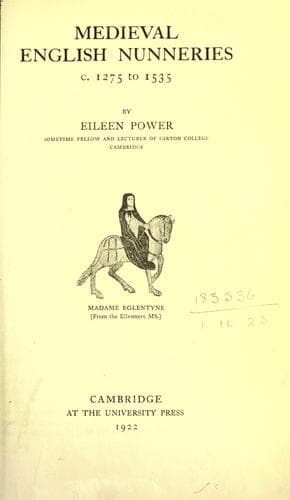
Medieval English Nunneries c. 1275 to 1535Power, Eileen
History
Medieval English Nunneries c. 1275 to 1535
Power, Eileen
Convents -- England; Monastic and religious life of women -- History
Another habit against which bishops constantly legislated was that of
having the children to sleep in the dorter with the nuns. This practice
was exceedingly common, for many of the nunneries which took children were
small and poor; they had possibly no other room to set aside for them, and
no person who could suitably be placed in charge of them. Moreover in some
cases adult boarders and servants also slept in the dorter. Alnwick was
constantly having to bid his nuns "that ye suffre ne seculere persones,
wymmen ne children lyg by nyghte in the dormytory," but Atwater and
Longland in the sixteenth century still have to make the same injunction.
Bokyngham in 1387 ordered that a seemly place outside the cloister should
be set apart for the children at Heynings; the reason was that (as
Gynewell had expressly stated on visiting this house forty years before)
"the convent might not be disturbed." Indeed little attempt was made by
the nuns to keep the children out of their way. They seem to have dined in
the refectory, when not in the separate rooms of their mistresses, for
Greenfield forbids the Prioress and Subprioress of Sinningthwaite (1315)
to permit boys or girls to eat flesh meat in Advent or Sexagesima, or
during Lent eggs or cheese, in the refectory, "contrary to the honesty of
religion," but at those seasons when they ought to eat such things, they
were to be assigned other places in which to eat them. There are
references, too, to disturbances and diversions created by the children in
the quire. At Elstow in 1442 Dame Rose Waldegrave said that "certain nuns
do sometimes have with them in time of mass the boys whom they teach and
these do make a noise in quire during divine service"[890]. To us the
picture of these merry children breaking the monotony of convent routine
is an attractive one; more attractive even than the pet dogs and the
Vert-Verts. But to stern ecclesiastical disciplinarians it was not so
attractive, and their constant restriction, though it never succeeded in
turning out the children, must have kept down the number who were
admitted.
The evidence which has so far been considered shows that, though the
reception of children to be boarded and taught in nunneries was fairly
common, it was subjected to well marked limitations. There remains to be
considered one more question the answer to which is in some sort a
limitation likewise. What exactly did the nuns teach these children? We
are hampered in answering this question by the difficulty of obtaining
exact contemporary evidence. Most modern English writers content
themselves with a glib list of accomplishments, copied without
verification from book to book, and all apparently traceable in the last
resort to Fuller and John Aubrey, the one writing a century, the other
almost a century and a half after the nunneries had been dissolved. Fuller
(whom Tanner copies) says:
Public-domain text, read in full here on John Shaqi.
Reviews
Reviews
No reviews yet
Be the first to share your thoughts on this work.
Elsewhere in the archive
Join the Discussion
Join the discussion
Sign in to leave a comment or review.
Sign InorCreate an account