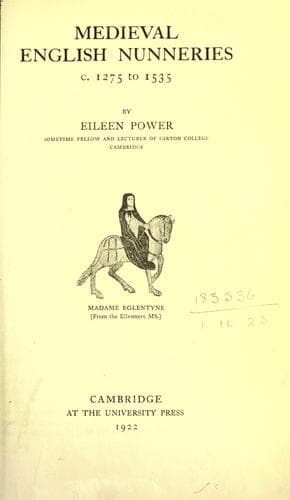
Medieval English Nunneries c. 1275 to 1535Power, Eileen
History
Medieval English Nunneries c. 1275 to 1535
Power, Eileen
Convents -- England; Monastic and religious life of women -- History
Nunneries also were good Shee-schools, wherein the girles and maids of
the neighbourhood were taught to read and work; and sometimes a little
Latine was taught them therein. Yea, give me leave to say, if such
Feminine Foundations had still continued ... haply the weaker sex
(besides the avoiding modern inconveniences) might be heightened to a
higher perfection than hitherto hath been obtained[891].
Aubrey, speaking of Wiltshire convents says:
There the young maids were brought up ... at the nunneries, where they
had examples of piety, and humility, and modesty, and obedience to
imitate, and to practise. Here they learned needle-work, the art of
confectionary, surgery (for anciently there were no apothecaries or
surgeons--the gentlewomen did cure their poor neighbours: their hands
are now too fine), physic, writing, drawing etc.[892]
One would have thought the familiar note of the _laudator temporis acti_
to be plainly audible in both these extracts. But a host of modern writers
have gravely transcribed their words and even, taking advantage no doubt
of Aubrey's "etc." (much virtue in etc.), improved upon them. In the work
of one more recent writer the list has become "reading, writing, some
knowledge of arithmetic, the art of embroidery, music and French 'after
the scole of Stratford atte Bowe,' were the recognised course of study,
while the preparation of perfumes, balsams, simples and confectionary was
among the more ordinary departments of the education afforded"[893].
Another adds a few more deft touches: "the treatment of various disorders,
the compounding of simples, the binding up of wounds, ... fancy cookery,
such as the making of sweetmeats, writing, drawing, needlework of all
kinds and music, both vocal and instrumental"[894]. The most recent writer
of all gives the list as "English and French ... writing, drawing,
confectionary, singing by notes, dancing, and playing upon instruments of
music, the study also of medicine and surgery"[895]. Though the historian
must groan, the student of human nature cannot but smile to see music
insinuate itself into the list and then become "both instrumental and
vocal"; confectionery extend itself to include perfumes, balsams, simples,
and the making of sweetmeats; arithmetic appear out of nowhere; and (most
magnificent feat of the imagination) dancing trip in on light fantastic
toe. From this compound of Aubrey, memories of continental convents in the
seventeenth and eighteenth centuries and familiarity with the convent
schools of our own day, let us turn to the considered opinion of a more
sober scholar, who bases it only upon contemporary evidence:
Public-domain text, read in full here on John Shaqi.
Reviews
Reviews
No reviews yet
Be the first to share your thoughts on this work.
Elsewhere in the archive
Join the Discussion
Join the discussion
Sign in to leave a comment or review.
Sign InorCreate an account