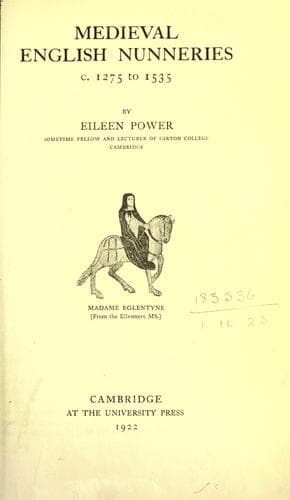
Medieval English Nunneries c. 1275 to 1535Power, Eileen
History
Medieval English Nunneries c. 1275 to 1535
Power, Eileen
Convents -- England; Monastic and religious life of women -- History
these arts, it may be replied that the children whom we find at nunneries
probably had opportunity to learn them at home, for they seem sometimes
to have spent only a part of the year with the nuns. It is true that board
is sometimes paid for the whole year, and that little Bridget Plantagenet
stayed at St Mary's Winchester for two or three years, while her parents
were absent in France; moreover we have already heard of poor Elizabeth
and Jane Knyghte, left for over five years at Cornworthy. But an analysis
of the Swaffham Bulbeck accounts shows that the children (if indeed they
are children) stayed for the following periods during the year 1483, viz.,
two for forty weeks, one for thirty weeks, one for twenty-six weeks, two
for twenty-two weeks, one for sixteen weeks, one for twelve weeks and one
for six weeks. It is much more likely that girls were sent to the nuns for
elementary schooling than for the acquirement of worldly accomplishments.
As has already been pointed out, it is difficult to get any specific
information as to the life led by the schoolchildren in nunneries. But by
good fortune some letters written by an abbess shortly before the
Dissolution have been preserved and give a pleasant picture of a little
girl boarding in a nunnery. The correspondence in question took place
between Elizabeth Shelley, Abbess of St Mary's Winchester, and Honor,
Viscountess Lisle, concerning the latter's stepdaughter, the lady Bridget
Plantagenet, who was one of the twenty-six aristocratic young ladies then
at school in the nunnery[902]. Lord Lisle was an illegitimate son of
Edward IV, and had been appointed Lord Deputy of Calais in 1533; and when
he and his wife departed to take up the new office, they were at pains to
find suitable homes for their younger children in England. A stepson of
Lord Lisle's was boarded with the Abbot of Reading and his two younger
daughters, the ladies Elizabeth and Bridget Plantagenet, were left, the
one in charge of her half-brother, Sir John Dudley, and the other in that
of the energetic Abbess of St Mary's Winchester. It must be admitted that
the correspondence between the abbess and Lady Lisle shows a greater
preoccupation with dress than with learning. The Lady Bridget grew like
the grass in springtime; there was no keeping her in clothes.
Public-domain text, read in full here on John Shaqi.
Reviews
Reviews
No reviews yet
Be the first to share your thoughts on this work.
Elsewhere in the archive
Join the Discussion
Join the discussion
Sign in to leave a comment or review.
Sign InorCreate an account